
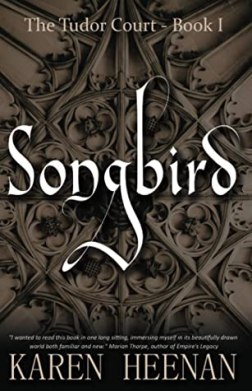
 We all know about the man who would become King Henry VIII. We know about his love life and his ever-changing views on religious reform, yet a side of the infamous king rarely explored; his love of music. Henry’s court in literature is often viewed through the lenses of those who held power in government and the lady’s maids, but what if it was considered from a different perspective? What if it was viewed from the perspective of one of the performers of King Henry VIII’s court? What might their experiences have been like singing their hearts out for the rich and glamorous? Karen Heenan tries to give her readers a better look into the world of Music with Bess, the titular character of her first novel in The Tudor Court series, “Songbird.”
I want to thank Karen Heenan for sending me a copy of this novel. I hosted a book tour for Karen a few months back for this book, so I was intrigued by this novel.
Beth is a ten-year-old girl who has a voice like an angel. One day, her father brought her to the court of Henry VIII to serve the king as one of his majesty’s minstrels. It is there that Bess meets a boy a year younger than her named Tom, who plays numerous instruments, but he prefers the lute. They form a bond that will last for years. Yet, as the friends grow closer, romance enters the picture, and the friends must navigate the ever-changing world of Henry VIII’s court during the time of the Great Matter.
What makes this book sensational is that the Tudors that we are familiar with, Henry VIII, Catherine of Aragon, and Anne Boleyn, tend to act as secondary characters, quite like a work by CJ Sansom. The focus is really on the music and the lives of the musicians. It shows just enough of the glitz and the glam of court life to get. The songs that Heenan included in this novel are so melodic that I could imagine the scenes without hearing the pieces aloud.
Oh boy, this book was an absolute treat. It was also a ride in the best sense. Bess and Tom go through many hurdles, including death, heartbreak, politics, and a good old-fashioned love triangle as a cherry on top. The world of the minstrels is full of its scandals, and it is just as brilliant as the court they entertain. There were points in this book where Bess or Tom made a mistake, and I just wanted to scream at them, but I couldn’t put this book down. These characters are so loveable that you will get emotionally attached to them.
To combine the story of the Great Matter with the lives of the minstrels like Beth and Tom is simply brilliant. If you want a historical fiction novel that gives a fresh take on the tumultuous Tudors, you should check out “Songbird” by Karen Heenan. Heenan gorgeously wrote this novel to portray the human experience through the reign of Henry VIII vividly.
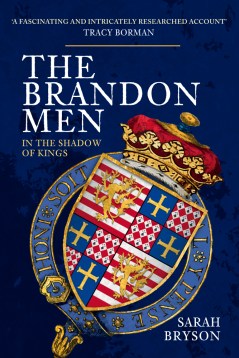 Loyalty to one’s king was imperative during times of war and strife. This statement was painfully true during periods of civil war when cousins fought against cousins. The Wars of the Roses was where we see families rise and fall like the tides, depending on which side they were loyal to and who was on the throne. One family who was able to navigate this political quagmire and end up on the side that would win in the end was the Brandons. Many recognize the name Brandon because of Charles Brandon and his rise in the court of Henry VIII, but how did they reach that point? What are the origins of the Brandon family? In her latest book, “The Brandon Men: In the Shadow of Kings”, Sarah Bryson takes her readers on a ride to find out what loyalty to the crown gave this family and why their legacy lives on today.
 Two cousins fighting for the right to rule England during the 16th century. One was the daughter of Henry VIII and Anne Boleyn who fought tooth and nail to rule without a man by her side. The other was the daughter of Mary of Guise and King James V of Scotland whose marriage record would prove to be fatal. Elizabeth I and Mary, Queen of Scots, may have been sister queens, but the way they were treated in their own countries differed completely. While Elizabeth I was praised and protected from harm in England, Mary was a scapegoat for so many in Scotland. The way that Mary was used as a pawn even though she wore a crown was nothing short of extraordinary. The story of how these two queens came on a collision course that would leave one queen beheaded and the other forever changed has been told in many different ways from both sides of the tale, but it has rarely been told as a cohesive nonfiction book. That is until Kate Williams’ marvelous biography, “The Betrayal of Mary, Queen of Scots: Elizabeth I and Her Greatest Rival”.
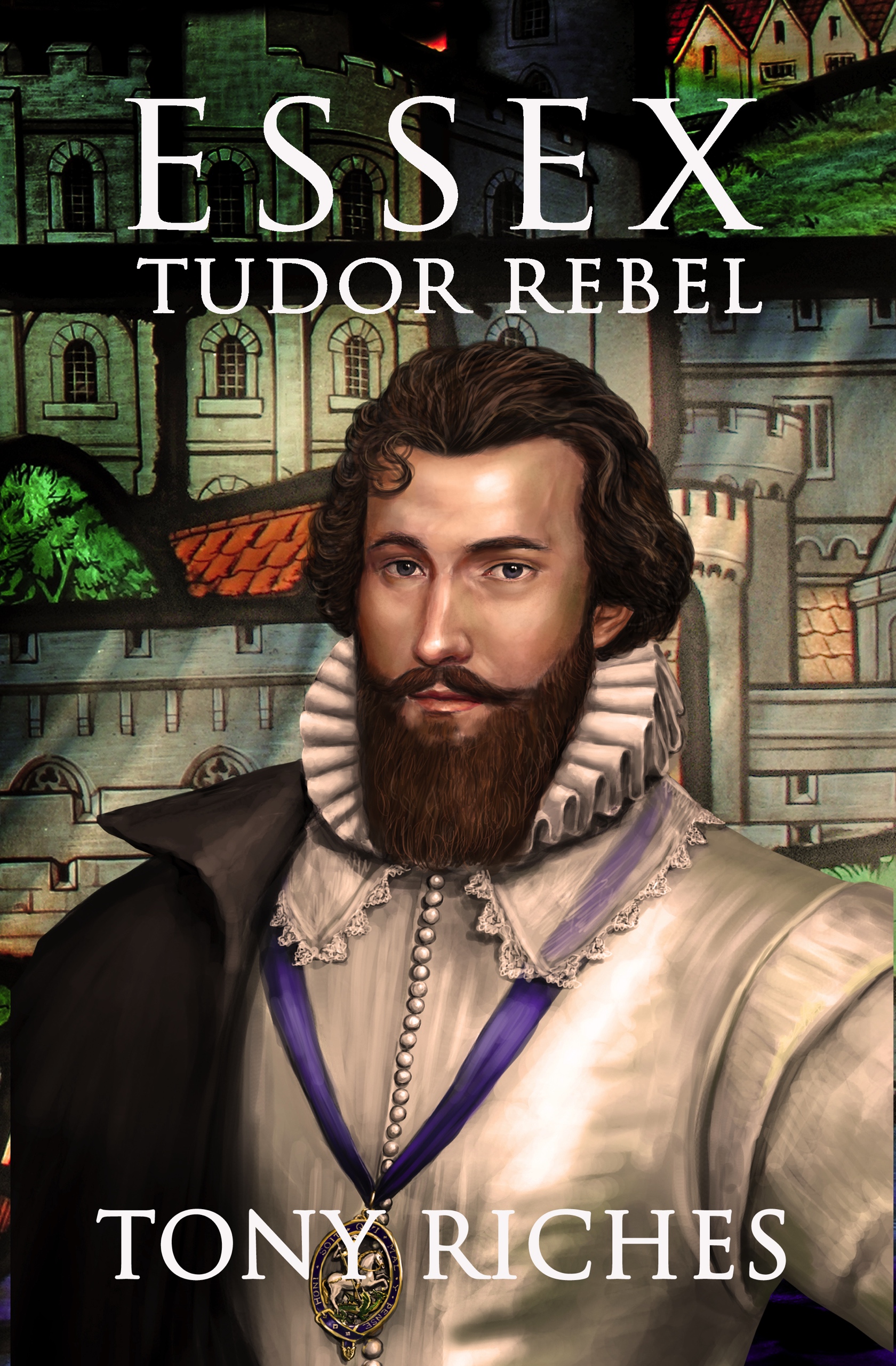
 Today, I am pleased to share my book review of the latest Elizabethan novel by Tony Riches as my contribution to his “Essex: Tudor Rebel” blog tour. Thank you to Tony Riches for sending me a copy of his latest novel, and to The Coffee Pot Book Club for allowing me to take part in this tour.
  (Blurb)
 Author Bio
 The year is 1586 and Ursula Blanchard is on a mission to protect Queen Elizabeth I. After returning home from a previous mission, Ursula and her household come into contact with a countrywoman named Etheldreda Hope who has brought a peculiar case to the forefront. In the forest by the village that Etheldreda calls home, there have been strange rituals occurring that include reference to an evil queen. Are these rituals harmless or is there a sinister motive behind the beliefs of the pagans who meet in the forest? Will Ursula and her household solve the case in time? This is the premise of Fiona Buckley’s latest Ursula Blanchard Tudor mystery, “Forest of Secrets”.
 Have you ever read a history book and wondered what life was really like for those who lived in the past? To understand a time period and the motives of the people of the past, we have to understand the structure of their society. How they understood things like class, sex, violence, government, and religion is essential for us to understand what separates us from our ancestors. What they ate, what they wore, and where they slept also give a unique insight into the time period. It can be a difficult undertaking to figure out all of the different aspects of the past connect and to present it cohesively, yet acclaimed historian Ian Mortimer has embraced this challenge head-on to tackle one of the most complex periods of the past; the Elizabethan era. His love letter to the Elizabethan age entitled, “The Time Traveler’s Guide to Elizabethan England” is a delightfully imaginative guide to the past.
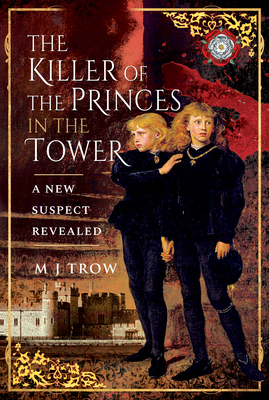 In 1483, King Edward IV’s family received a devastating announcement; the king in the prime of his life died, leaving the throne to his young son Edward V. However, neither Edward V nor his younger brother Richard of York would ever see the throne. Instead, they were taken to the Tower of London by their protector, Richard of Gloucester, for protection, never to be seen again. For over five hundred years, many theories have emerged about what happened to the princes in the tower and who might have possibly killed the boys. In MJ Trow’s latest book, “The Killer of the Princes in the Tower: A New Suspect Revealed”, he works hard to uncover the truth of what might have happened to the sons of King Edward IV.
 The last Tudor monarch, Queen Elizabeth I, was known for many things, but her main legacy is that she never chose to marry anyone. She was the infamous “Virgin Queen”. However, there were those around her who manage to capture her attention and her admiration for a time. The most famous of these men was Robert Dudley, Earl of Leicester. He was a massive supporter of the arts and the Protestant faith, gaining prestige and praise from his highly exalted monarch. Yet, his life and his relationship with his wives, his enemies, and Elizabeth I was full of dangers and numerous scandals. Who was this man who wooed the heart of the most eligible woman in all of 16th century Europe? Robert Stedall investigates the relationship between these two lovers destined to never marry each other in, “Elizabeth I’s Secret Lover: Robert Dudley, Earl of Leicester”.
 “Uneasy lies the head that wears the crown.” This famous quote from William Shakespeare’s play Henry IV, Part III has been used throughout the centuries to describe how difficult it is to rule a country for any duration of time. Most kings and queens of the past lasted for a few years, but there was one queen who lasted for a handful of days. She was the successor of Henry VIII’s only male son, King Edward VI, and was meant to replace his eldest half-sister, who would become Queen Mary I. It was a battle between Protestantism and Catholicism with a 17-year-old scholar caught in the middle. Her name was Lady Jane Grey, but many refer to her as the “Nine Day Queen of England”. Lady Jane Grey’s tragically short story, how she became queen, and the consequences of her reign are discussed thoroughly in Nicola Tallis’ beautifully written debut biography, “Crown of Blood: The Deadly Inheritance of Lady Jane Grey”.
 Action, adventure, drama, heartache, and love are what people crave when they read fictional stories. Yet, these elements are ever-present in the stories from the past. Each one of these topics could be explored in numerous ways when we are discussing history, but an area in history where romance and love were intermingled with politics was Elizabethan England. Queen Elizabeth I was obviously known as the “Virgin Queen” because she chose not to marry, but that did not mean that her subjects were banned from love and marriage. How did Elizabethans view the ideas of love, marriage, and sex? In this book, “Sex, Love, and Marriage in the Elizabethan Age”, R.E. Pritchard sets out to explore what love, marriage, and the intimate moments meant to Elizabethans of every class.
 Adventures of a Tudor Nerd