
 The age of the Tudors has fascinated historians for centuries. As of recently, there has been a shift in how we view historical figures. Historians have been stripping away the more controversial elements that have been ingrained in how we view historical figures to look for the truth. Historical figures like Anne and Mary Boleyn have been placed under the microscope and have been given a closer look in recent years. But what about the men of Boleyn family, Thomas, and George? What were their lives really like? Did they truly desire power and titles so much that they were willing to do anything to get it? Those are the questions that Lauren Mackay decided to explore in her latest book, “Among the Wolves of Court: The Untold Story of Thomas and George Boleyn.”
Mackay explains her goal for writing this book about Thomas and George Boleyn:
This book attempts to dispel the traditional stereotypes, relying on the textual traces of both Boleyn men, which are dispersed in a wide variety of sources across English and European archives and libraries. I want to present a more complete account of these men- their political and personal trajectories, the evolution of their careers, and what mattered to them. Where judgment can be made it has been done so cautiously. In the absence of any extensive scholarly consideration, they have remained captive to a dated historiography which is a reflection of the frame within which the world continues to view them, and from which this book seeks to unburden them. While this is a biography of two generations of Boleyns, I should note that there is far more evidence on Thomas than George, whose career had barely taken off before he was executed, therefore a great deal of the book naturally follows Thomas’ lengthy career with George brought in as the evidence allows. (Mackay, 5).
In order to understand the Boleyns, Mackay begins her book with a brief history of the Boleyn family and how they were able to come into the service of the English monarchy. It is interesting to read how the Boleyns came from such humble beginnings and their loyalty to the Tudors and the Lancastrians during the Wars of the Roses. While brief, this part of this book is imperative to understand how loyal and hardworking the Boleyn men were, especially the father Thomas Boleyn.
Both Thomas and George were diplomats and were part of embassies and special envoys in order to establish good relationships with other countries through discussions and treaties. Mackay takes time to explain these political terms for those readers who do not understand how 16th-century politics work. As someone who wanted to know more about the political system of the 16th century, this helped me quite a bit. Thomas earned respect and many of his titles through his own merits, although there are some who believe that he gained some of his titles through his daughters’ affairs with King Henry VIII. We see the rise of the Boleyns as well as the inevitable fall of Anne and George that lead to their executions.
Lauren Mackay gives us a more realistic perspective of Thomas and George Boleyn. They were not men who would do anything for power. Thomas was a man loyal to the crown and his family while George was a young and naive man who was trying to follow in the footsteps of his father. Thomas and George had their names dragged through the mud by people who did not like them. Mackay’s book breathes new life to the legacy of the Boleyns. “Among the Wolves of Court: The Untold Story of Thomas and George Boleyn” by Lauren Mackay is a perfect introduction for anyone who is interested in the inner workings of the English court during the early years of Henry VIII’s reign and a fascinating look into the Boleyns and their legacy.
 The Wars of the Roses is often remembered for the battles that were fought in England. Bosworth. Towton. Barnet. Tewkesbury. These battles and the names of the men and women like Richard III, Margaret of Anjou, Henry VI, Richard Duke of York, Edward IV and the Tudors are etched into the history of England. However, what started this conflict was not on the battlefield, it was inside the English Court. The decisions of a few men led to revolts that swept throughout England. So what was life like during this tumultuous time in English history? That is one of the questions that Conn Iggulden wanted to explore in his book series, “Wars of the Roses”. The first book in the series is called “Stormbird” and it explores the time after Henry VI marries Margaret of Anjou as well as Cade’s Rebellion, which wanted to tear England apart.
 The Wars of the Roses was a time full of fascinating people, both men, and women. They chose to live their lives to the best of their abilities. They had to decide who they were loyal to and, in some circumstances, they had to switch sides in order to survive. They had to chose to take destiny in their own hands, even if the decisions they had to make were controversial to others. This would perfectly describe the protagonist of Philippa Gregory’s book, “The Lady of the Rivers”. This is the story of Jacquetta Woodville, the mother of Elizabeth Woodville and a woman who took destiny into her own hands
 The everyday life of those who lived in the past has been an area of fascination for those who study any period in history. We often wonder what it was like to dress like a person in the court of Henry VIII or Elizabeth I, what their diets were like, and how they interacted with one another, either in the royal court or as commoners working everyday to make a living. One of the areas that is always mentioned is the health of a monarch. In the case of the Tudors, when we speak of health, many look to Henry VIII as he had a lot of different medical conditions and accidents that affected his life. What was 16th century medical practices like? How did doctors treat their patients in the time of the Tudors? This has been an area of Tudor life that has not received much attention. That is until now. Seamus O’ Caellaigh gives us an in-depth look at the treatments fit for King Henry VIII from the doctors who actually treated the king in his book, “Pustules, Pestilence and Pain: Tudor Treatments and Ailments of Henry VIII”.
  The Boleyn family is one of the most notable families during the reign of the Tudors. When one thinks about this family, people like Anne Boleyn, Thomas Boleyn, and George Boleyn come to mind. However, another Boleyn and her family story have been emerging from the shadows of history in recent years. That is the story of Mary Boleyn, a mistress of King Henry VIII. Mary Boleyn had a daughter named Catherine Carey, who married Sir Francis Knollys and was the mother of 14 children, including Lettice Knollys. Since Catherine Carey was a direct relation to the Tudors, what might have her life have been like? Adrienne Dillard wanted to give readers a possible view of Catherine Carey’s life in her book, “Cor Rotto: A Novel of Catherine Carey”.
 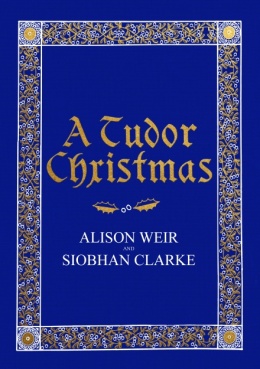 Christmas is seen today as a time of gift giving, twinkling lights and joy. We often celebrate it only one day a year, on December 25th, and then we celebrate a few days later the New Year from December 31st to January 1st. However, in the past, Christmas and New Years were a part of 12 days of celebrations. We often think that our traditions for Christmas date from the time of the Victorians, but that may not be the case. In fact, some of our more time-honored traditions for the holidays may in fact date from the Tudors and further back in history. So what are these traditions and how was Christmas celebrated in the time of the Tudors? That is the topic that Alison Weir and Siobhan Clarke wanted to explore in their book, “A Tudor Christmas”.
  After the death of Henry VIII and Edward VI, there was an explosion of religious intolerance, not just in England, but in Europe as a whole. Many believe that it was Mary I “Bloody Mary” who really started this trend, however, the fires of hatred between Protestants and Catholics extended further into the reigns of Elizabeth I and James I of England. We often focus on the monarchs and their inner circles during this time and how the religious persecutions affected the decisions that they made. That tells only part of the story, but how did this religious fighting between Protestants and Catholics affect the normal person? What were their lives like? Ken Follett explores this topic in his third book in his historical fiction series, the Kingsbridge Series, “A Column of Fire”.
  The houses of York, Lancaster, the Nevilles, the Howards, the Mowbrays, the Percys, and the Tudors are often recognized as the families involved in the Wars of the Roses. However, there was one more house that was just as important as the others; the Beauforts. The Beauforts were the sons and daughters of John of Gaunt, Duke of Lancaster and his mistress Katherine Swynford. They were considered bastards since they were born out of wedlock, yet they were connected to the house of Lancaster and rose to power by their own right. They would help change not only English history but the history of Europe forever. The Beauforts made a huge impact during the Hundred Years War and the Wars of the Roses, yet many people only recognize Margaret Beaufort and Edmund Beaufort 2nd Duke of Somerset. The Beauforts don’t get much attention. Nathen Amin, the founder of The Henry Tudor Society, wanted to tell the story of this remarkable family. It is in his book “The House of Beaufort: The Bastard Line that Captured the Crown”, that the Beauforts are given the attention that they rightfully deserve.
 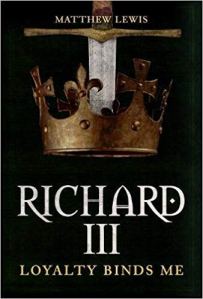 When we study history and look at certain people, we often have a tendency to treat them almost like fictional characters. They are either the hero, all good with no flaws, or villains, all bad where we only focus on their flaws. We don’t see the person as “human”, neither good nor bad, just someone who tried their lives to the best of their abilities. One such person who tends to get either the hero or the villain treatment is King Richard III of England. To some, he is “white knight”, a man who was wrongly accused and who was faultless. To others, he was a “black legend”, a dastardly villain who wanted power and did not care who he stepped on in order to achieve his goals. With these two different portrayals of Richard III, we often forget that he was just an ordinary man who became king. Matthew Lewis has decided to strip away both the white and black portrayals of Richard III and explore who Richard III the man was in his latest book, “Richard III: Loyalty Binds Me.”
 Henry VIII is one of the most notorious kings who ever ruled England. He had six wives, two of which were executed, three legitimate children who would change England forever, and he decided to break from Rome and create his own church. Henry was such a larger than life figure, yet when it comes to historical fiction, he tends to play a smaller part in books about his six wives and is often portrayed as a villain. Henry doesn’t get to have his own voice, in historical fiction, on some of the most important parts in his life, so Margaret George decided to give him one in her book, “The Autobiography of Henry VIII: With Notes by His Fool, Will Somers,” to explain what could have been going on in his mind during these pivotal moments.
 Adventures of a Tudor Nerd