
 Queen Elizabeth I, “the Virgin Queen”, was the daughter of King Henry VIII and his second wife Anne Boleyn. She was the step sister to Edward VI and Mary I. Her story is full of so many twists and turns, starting from the very beginning, that it is almost a miracle that she lived and became queen. So what type of trials and tribulations did Elizabeth go through to become one of the most successful rulers in English history? What was her life like? Anne Somerset decides to explore these questions, and more, in her book, “Elizabeth I”.
Anne Somerset puts Elizabeth’s reign into perspective:
When Elizabeth ascended the throne, her kingdom was weak, demoralized and impoverished. A member of Parliament subsequently recalled how at her accession, England was ‘in war with foreign nations, subject to ignorant hypocrisy and unsound doctrine, the best sort under great persecution, some imprisoned, some driven to exile for their conscience, the treasure… corrupt.’. Under Elizabeth, the nation regained its self-confidence and sense of direction. At a time when the authority of the majority of her fellow monarchs was under threat or in decline, she upheld the interests of the Crown while not encroaching on those of her subjects, restored the coinage, and created a Church which, for all its failings, came close to being truly national. While many European countries were being rent by civil war, insurrection and appalling acts of bloodshed , she presided over a realm which (with the exception of her Irish dominions) was fundamentally stable and united. She herself was proud of the contrast between the condition of her own kingdom and that of others….Besides this, Elizabeth was responsible for raising England’s international standing, defying the most powerful nation in Christendom, and frustrating Philip II’s attempts to overrun both England and France. (Somerset, 570).
Anne Somerset begins her book with Elizabeth’s birth, the fall of her mother Anne Boleyn, and the death of her father Henry VIII. She then transitions to where Elizabeth was during the reigns of her step siblings, Edward VI and Mary I, which includes her take on Elizabeth’s relationship with Thomas Seymour and Catherine Parr. Somerset does not spend a lot of time in this part of Elizabeth’s life because her real focus is Elizabeth I and her reign.
Starting with Elizabeth’s coronation and the first year of her reign, Somerset breaks her chapters down by certain years and the different conflicts that occurred during that time. I did appreciate this aspect of her book, but it did make for very long chapters. The middle of her book had a chapter on Elizabeth’s court and culture, which I found quite appropriate since the court was the center of Elizabeth’s world. Somerset included information that tends to be overlooked in other biographies of Elizabeth I. For example, she went into depth about the Ridolfi Plot, which was before the famous Babington Plot, and is often overlooked. It is that attention to detail which I found rather enjoyable.
While I was reading this book, it felt like I was discovering a new side of Elizabeth I, which I loved. I have read many biographies about Elizabeth I since she was my favorite Tudor queen, but this one felt different. I actually learned a lot of new information about Elizabeth and her reign that I did not know. If you want a fresh take on Elizabeth I, her life and her reign, I highly encourage you to read Anne Somerset’s book “Elizabeth I”.
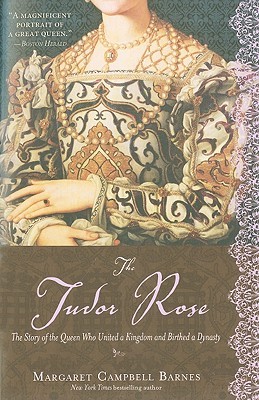 The beginning of the Tudor Dynasty was full of action and drama. Richard III and Henry Tudor met on the battlefield at Bosworth on August 22, 1485 to determine who would be the King of England. Richard III fell and Henry Tudor triumph, becoming Henry VII. However, there was another person whose fate was determined on that battlefield; Elizabeth of York, daughter of Edward IV and Elizabeth Woodville. It was at this battle that Elizabeth knew that she would marry Henry Tudor and become queen of England. But what was it like for her to live through this time of change? From the death of her father to the case of her missing brothers. From to Richard III’s short reign to her relationship with her husband Henry VII and her children. How did she feel during the most difficult times in her life? Margaret Campbell Barnes explores this question in her novel, “The Tudor Rose”.
 The Wars of the Roses was a dynastic battle between the houses of York and Lancaster for the throne of England that lasted for 30 years. There were plenty of people who lived during this time that continue to fascinate us even to this day. Men like Richard III, Henry VI, Edward IV, Henry VII, and Richard Neville duke of Warwick to just name a few. There were also women who worked hard on the sidelines to make sure that their sides would win the wars. Women like Margaret of Anjou, Elizabeth Woodville, Cecily Neville, and Margaret Beaufort. However, one of the most important person during this conflict tends to get left behind when discussing the most influential people of this conflict; Elizabeth of York, the wife of Henry VII. She was the mother of the Tudor dynasty, yet she does not get the attention that she rightfully deserves. In Alison Weir’s book “Elizabeth of York: A Tudor Queen and Her World”, Weir explores the life of this influential woman and her impact on the world around her.
 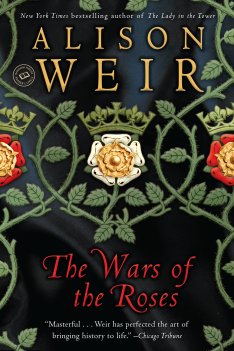 The Wars of the Roses was a series of wars from 1455 until 1487 for the throne of England. It is traditionally taught that it was between the houses of York and Lancaster, yet there were a lot more players involved than these two families. In fact the conflict started much earlier with the children of Edward III and Philippa of Hainault. The Lancasters were the descendants of John of Gaunt and his wife Blanche of Lancaster while the Yorks were descendants of Edmund of Langley Duke of York. This was a series over the question of who had the strongest claim to the throne. This question and the series of wars that would try to answer it is explored in depth in Alison Weir’s book “The Wars of the Roses”.
  The story of Elizabeth I is full of twists and turns. From the moment she was born, she had to fight to survive. Through all that she went through, Elizabeth found the strength and courage to become the legendary queen to help England to enter into a golden age of peace and prosperity. This, however, is just one side of Elizabeth. The other side of Elizabeth’s personality, her anger and her interactions with her councilors, is explored thoroughly in Carolly Erickson’s book “The First Elizabeth”.
  Elizabeth I was perhaps the most influential monarch in English history. There are episodes in her life that became legendary. From her tumultuous childhood to her reign where everyone either wanted her to marry or put someone else on the throne, Elizabeth’s life was hardly easy. Even though much is known about her public life as queen, we really do not know a lot about her private life. In Alison Weir’s book, “The Life of Elizabeth I”, the gap between the public Elizabeth and the private Elizabeth is bridged in order to give a more complete biography of this fascinating English queen.
 Anne Boleyn, the second wife of Henry VIII and the mother of Elizabeth I. Most of us know her story of how she fell in love with Henry VIII and how their relationship changed England forever as Henry broke off with Rome in order to get a divorce from his first wife Katherine of Aragon so that he could marry Anne. Unfortunately, when Anne couldn’t give Henry the son he so desired, their love began to fade. Anne Boleyn’s story ends in tragedy as she was accused of having multiple affairs, plotting the death of Henry VIII, and witchcraft, Anne was found guilty and was killed. Her fall happened in May 1536, a month that changed everything, but how much of these charges are true? Did she indeed have these affairs? Did she plot to kill her husband? What is the truth behind her fall? These are the questions that Alison Weir try to answer in her book “The Lady in the Tower: The Fall of Anne Boleyn.”
 Owen Tudor, the second husband of Catherine of Valois and the father of Edmund and Jasper Tudor. His affair with Catherine changed English history forever, yet not much is known about his past before he met Catherine. Was he married before he met Catherine and after she died? What must have been like for him as the Wars of the Roses began to take hold of England and everything he worked hard for began to fade away. The man who started as a Welsh servant turned step- father to King Henry VI and the grandfather of King Henry VII, the patriarch of the Tudor Dynasty, this is the protagonist in Tony Riches’ book, “Owen: Book One of the Tudor Trilogy”.
 Edward Seymour, the brother of Thomas and Jane Seymour, as well as the uncle of Edward VI. Many people remember him for his role as Lord Protector to his nephew as well as his role in the execution of his brother Thomas. That, however, is only a small snapshot into the life of an interesting man. His life after his sister Jane died and before he became the 1st Duke of Somerset was one of twists and turns. Nothing was safe for the brother of Henry VIII’s most beloved wife, especially when it came to dealing with his enemy at court, Bishop Stephen Gardiner. This is the time period that Janet Wertman has decided to explore in her latest book, “The Path to Somerset”, the second book in her Seymour saga (The first book of the Seymour saga is called “
 There were some men who tried to court Elizabeth, including Robert Dudley, but none could ever get her to the altar. That was when she was queen, however, there was one man who was very close to marrying her when she was just Elizabeth Tudor. The man was Thomas Seymour, the brother of Edward and Jane Seymour and the husband of Catherine Parr. In Elizabeth Norton’s book, “The Temptation of Elizabeth Tudor: Elizabeth I, Thomas Seymour, and the Making of a Virgin Queen”, she explores the relationship between Thomas and Elizabeth and why he was her temptation.
 Adventures of a Tudor Nerd