
 Medieval princes are often viewed as men who will one day be king of their homeland or another country. They are seen as wealthy men with prestige and honor who live lavish lifestyles and go to war to earn titles and estates. One of these noble medieval princes was a man who married three times, including to his most beloved mistress. He was the son of Edward III, the uncle of Richard II, and the father of the queen of Castile and King Henry IV, the first Lancastrian king. His children, grandchildren, and great-grandchildren would rule in different European countries, even though he never had the chance to wear the crown of England or Castile for himself. His name was John of Gaunt, and his story is told in Kathryn Warner’s latest biography, “ John of Gaunt: Son of One King, Father to Another.”
I want to thank Amberley Publishing for sending me a copy of this book. John of Gaunt is one of my favorite Plantagenet figures to study, so when I heard about this title late last year, I was intrigued to read it. I wanted to see what new information Warner would provide in the research of John of Gaunt and his family.
Warner takes her readers on a journey from the birth of the third son of Edward III and Philippa of Hainault to his death in 1399. The matter that truly defined John of Gaunt’s life was his connections not only in England but throughout Europe, which Warner explains in great detail. We go on a journey through his three marriages; first to Blanche of Lancaster to become Duke of Lancaster, then to Constanza of Castile, who allowed him to try and fight for the kingdom of Castile, and finally his mistress Katherine Swynford. Katherine Swynford was the mother of the Beauforts who would help create the Tudor dynasty. However, not only his marital connections made Gaunt so well known. As the son of King Edward III and Philippa of Hainault, his family was connected to every corner of Europe through marriage. Even though John of Gaunt never became King of England or Castile, his family would fulfill his dream of ruling a kingdom and gaining wealth and prestige.
The will of John of Gaunt, written on the same day of his death, is included in its entirety, showing how wealthy this particular Plantagenet prince was at the time of his death. Unlike other biographies about John of Gaunt, this focuses on his family connections and financial records, Warner’s specialty. However, we tend to view John of Gaunt as a gallant prince. Those who lived in England as peasants considered him the enemy during his lifetime, especially during the Great Uprising in 1381, also known as The Peasants Revolt.
Kathryn Warner has once again illuminated the life of a famous Plantagenet figure through genealogical and financial records. Although he ended up becoming one of the most hated men in England and the enemy to his nephew Richard II, he would go down as one of the fascinating men to study from the Plantagenet dynasty. If you want to learn more about the founding of the Lancastrian dynasty and the rise of the Beauforts through John of Gaunt, I would recommend you read “John of Gaunt: Son of One King, Father to Another, “ by Kathryn Warner.
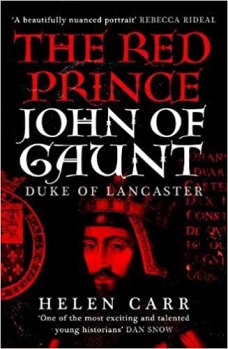 When one studies the history of the English monarchy, we tend to consider those who ruled and those who advised the ruler as significant characters. We rarely study the family members of the monarch who did not win the right to rule the kingdom. Yet, they are often either extremely loyal or they desire the crown with such ferocity that they rebel against their own family. It seems like a rather cruel world, but that was the life of a medieval monarch. True loyalty for one’s family was a rare feat. One man showed the depth of his loyalty to his family, even when the people despised him. He was the son of King Edward III, the brother of the famous Black Prince, the uncle of King Richard II, and the father of Henry Bolingbroke who would become King Henry IV. Gaunt’s reputation and legacy have been marred by his wealth and the role that he played with the Peasants’ Revolt, but was he such a bad person? In Helen Carr’s brilliant debut biography, “The Red Prince: The Life of John of Gaunt, the Duke of Lancaster”, she looks to uncover the truth about the man behind the throne and why he never desired the crown for himself.
 The Wars of the Roses was a time of great hardships and strong men and women who did everything they could in order to survive. One of these remarkable people was a woman who did everything she could to make sure her only son lived and prospered. She was the daughter of a man who, allegedly committed suicide, she had four different husbands and gave birth to her son at the age of thirteen. She helped organize rebellions and a marriage that helped her son win the throne of England. Her name was Margaret Beaufort, the mother of King Henry VII. Her remarkable story is told in Elizabeth Norton’s insightful book, “Margaret Beaufort: Mother of the Tudor Dynasty.”
 In recent years, the study of the English conflict known as the “Wars of the Roses” has become rather popular. The Lancasters and the Yorks fighting for the English throne. Only one can be the winner. When we do look at this time period, we tend to focus on the people involved in the battles and the political aspect of the conflict. The battles, how they were fought, and why the conflict started in the first place tend to be pushed to the sideline. That is not the case with this particular book. In Hugh Bicheno’s book, “Battle Royal- The Wars of the Roses: 1440-1462”, the political and military aspects combine with family histories for a comprehensive look into what made this time period so fascinating.
 The houses of York, Lancaster, the Nevilles, the Howards, the Mowbrays, the Percys, and the Tudors are often recognized as the families involved in the Wars of the Roses. However, there was one more house that was just as important as the others; the Beauforts. The Beauforts were the sons and daughters of John of Gaunt, Duke of Lancaster and his mistress Katherine Swynford. They were considered bastards since they were born out of wedlock, yet they were connected to the house of Lancaster and rose to power by their own right. They would help change not only English history but the history of Europe forever. The Beauforts made a huge impact during the Hundred Years War and the Wars of the Roses, yet many people only recognize Margaret Beaufort and Edmund Beaufort 2nd Duke of Somerset. The Beauforts don’t get much attention. Nathen Amin, the founder of The Henry Tudor Society, wanted to tell the story of this remarkable family. It is in his book “The House of Beaufort: The Bastard Line that Captured the Crown”, that the Beauforts are given the attention that they rightfully deserve.
 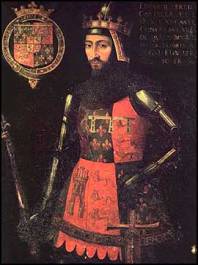 (Born March 6, 1340- Died March 15, 1399).
 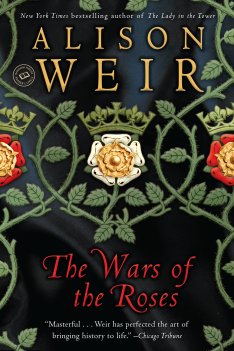 The Wars of the Roses was a series of wars from 1455 until 1487 for the throne of England. It is traditionally taught that it was between the houses of York and Lancaster, yet there were a lot more players involved than these two families. In fact the conflict started much earlier with the children of Edward III and Philippa of Hainault. The Lancasters were the descendants of John of Gaunt and his wife Blanche of Lancaster while the Yorks were descendants of Edmund of Langley Duke of York. This was a series over the question of who had the strongest claim to the throne. This question and the series of wars that would try to answer it is explored in depth in Alison Weir’s book “The Wars of the Roses”.
  Adventures of a Tudor Nerd