
 After the death of Henry VIII and Edward VI, there was an explosion of religious intolerance, not just in England, but in Europe as a whole. Many believe that it was Mary I “Bloody Mary” who really started this trend, however, the fires of hatred between Protestants and Catholics extended further into the reigns of Elizabeth I and James I of England. We often focus on the monarchs and their inner circles during this time and how the religious persecutions affected the decisions that they made. That tells only part of the story, but how did this religious fighting between Protestants and Catholics affect the normal person? What were their lives like? Ken Follett explores this topic in his third book in his historical fiction series, the Kingsbridge Series, “A Column of Fire”.
Every historical fiction book needs a great opening to engage the reader and Ken Follett delivers with his prologue:
We hanged him in front of Kingsbridge Cathedral. It is the usual place for executions. After all, if you can’t kill a man in front of God’s face you probably shouldn’t kill him at all. The sheriff brought him up from the dungeon below the guildhall, hands tied behind his back. He walked upright, his pale face defiant, fearless. The crowd jeered at him and cursed him. He seemed not to see them. But he saw me. Our eyes met, and in that momentary exchange of looks, there was a lifetime. I was responsible for his death, and he knew it. I had been hunting him for decades. He was a bomber who would have killed half the rulers of our country, including most of the royal family, all in one act of bloodthirsty savagery- if I had not stopped him. I have spent my life tracking such would-be murderers, and a lot of them have been executed- not just hanged but drawn and quartered, the more terrible death reserved for the worst offenders. Yes, I have done this many times: watched a man die knowing that I, more than anyone else, had brought him to his just but dreadful punishment. I did it for my country, which is dear to me; for my sovereign, whom I serve; and for something else, a principle, the belief that a person has the right to make up his own mind about God. He was the last of many men I sent to hell, but he made me think of the first…”(Follett, prologue).
This story follows the lives of several different people and their families, but the main story focuses on a man named Ned Willard. After he can’t marry the girl he loves, Margery Fitzgerald, and his family is crushed by bad investments, he decides to work for a young Elizabeth Tudor, who would later become Elizabeth I. His works will lead him all over England and Europe to help thwart plots to kill Elizabeth and replace her with a Catholic ruler. One of his biggest opponents is the elusive Jean Langlais, a man who works in the shadows, yet he is closer than Ned thinks.
What Follett does so well is that he incorporates people from other countries into this story. Sylvie Palot from France, the young Protestant bookseller, who is not afraid to sell Bibles to those who wish to own a Bible. Pierre Aumande, the man who will do anything in order to gain power. Alison McKay, the fictitious best friend of Mary Queen of Scots, who would do anything for her queen. Ebrima Dabo, a slave who will do anything to be free. Barney Willard, Ned’s brother, who wants nothing in life, except to sail the high seas looking for adventure.
Follett’s cast of original characters adds a depth to an already tumultuous time in European history. Follett is able to blend the fictitious characters with real historical figures and actual events like the St. Bartholomew’s Day Massacre, the death of Mary Queen of Scots, and the Spanish Armada.
This is my first book by Ken Follett and I have to say I thoroughly enjoyed it. There were so many twists and turns in this story that I was not expecting that I really could not stop reading this book. I found it rather engaging and exciting. I found it interesting that Follett decided to end the book during the reign of James I and that he called King Philip II of Spain by his other less common Spanish name Felipe. These are more stylistic choices instead of historical choices.
Overall as a historical fiction book about the religious persecution in the Elizabethan era, I found this book dynamic and thrilling. Although this is the third book in a series, I believe it can stand on its own. After reading this book, I really want to go back and read the first two books of the series. If you want a great historical fiction book that you can easily get lost in, I enthusiastically recommend you read “A Column of Fire” by Ken Follett.
 The houses of York, Lancaster, the Nevilles, the Howards, the Mowbrays, the Percys, and the Tudors are often recognized as the families involved in the Wars of the Roses. However, there was one more house that was just as important as the others; the Beauforts. The Beauforts were the sons and daughters of John of Gaunt, Duke of Lancaster and his mistress Katherine Swynford. They were considered bastards since they were born out of wedlock, yet they were connected to the house of Lancaster and rose to power by their own right. They would help change not only English history but the history of Europe forever. The Beauforts made a huge impact during the Hundred Years War and the Wars of the Roses, yet many people only recognize Margaret Beaufort and Edmund Beaufort 2nd Duke of Somerset. The Beauforts don’t get much attention. Nathen Amin, the founder of The Henry Tudor Society, wanted to tell the story of this remarkable family. It is in his book “The House of Beaufort: The Bastard Line that Captured the Crown”, that the Beauforts are given the attention that they rightfully deserve.
 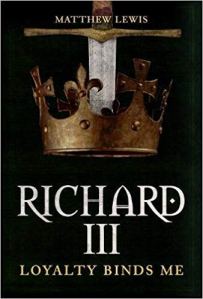 When we study history and look at certain people, we often have a tendency to treat them almost like fictional characters. They are either the hero, all good with no flaws, or villains, all bad where we only focus on their flaws. We don’t see the person as “human”, neither good nor bad, just someone who tried their lives to the best of their abilities. One such person who tends to get either the hero or the villain treatment is King Richard III of England. To some, he is “white knight”, a man who was wrongly accused and who was faultless. To others, he was a “black legend”, a dastardly villain who wanted power and did not care who he stepped on in order to achieve his goals. With these two different portrayals of Richard III, we often forget that he was just an ordinary man who became king. Matthew Lewis has decided to strip away both the white and black portrayals of Richard III and explore who Richard III the man was in his latest book, “Richard III: Loyalty Binds Me.”
 Henry VIII is one of the most notorious kings who ever ruled England. He had six wives, two of which were executed, three legitimate children who would change England forever, and he decided to break from Rome and create his own church. Henry was such a larger than life figure, yet when it comes to historical fiction, he tends to play a smaller part in books about his six wives and is often portrayed as a villain. Henry doesn’t get to have his own voice, in historical fiction, on some of the most important parts in his life, so Margaret George decided to give him one in her book, “The Autobiography of Henry VIII: With Notes by His Fool, Will Somers,” to explain what could have been going on in his mind during these pivotal moments.
 Queen Elizabeth I, “the Virgin Queen”, was the daughter of King Henry VIII and his second wife Anne Boleyn. She was the step sister to Edward VI and Mary I. Her story is full of so many twists and turns, starting from the very beginning, that it is almost a miracle that she lived and became queen. So what type of trials and tribulations did Elizabeth go through to become one of the most successful rulers in English history? What was her life like? Anne Somerset decides to explore these questions, and more, in her book, “Elizabeth I”.
 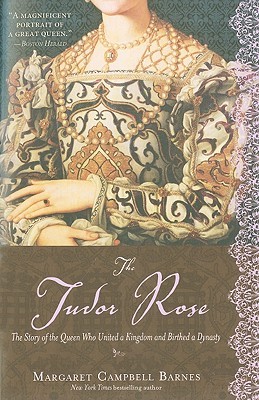 The beginning of the Tudor Dynasty was full of action and drama. Richard III and Henry Tudor met on the battlefield at Bosworth on August 22, 1485 to determine who would be the King of England. Richard III fell and Henry Tudor triumph, becoming Henry VII. However, there was another person whose fate was determined on that battlefield; Elizabeth of York, daughter of Edward IV and Elizabeth Woodville. It was at this battle that Elizabeth knew that she would marry Henry Tudor and become queen of England. But what was it like for her to live through this time of change? From the death of her father to the case of her missing brothers. From to Richard III’s short reign to her relationship with her husband Henry VII and her children. How did she feel during the most difficult times in her life? Margaret Campbell Barnes explores this question in her novel, “The Tudor Rose”.
 The Wars of the Roses was a dynastic battle between the houses of York and Lancaster for the throne of England that lasted for 30 years. There were plenty of people who lived during this time that continue to fascinate us even to this day. Men like Richard III, Henry VI, Edward IV, Henry VII, and Richard Neville duke of Warwick to just name a few. There were also women who worked hard on the sidelines to make sure that their sides would win the wars. Women like Margaret of Anjou, Elizabeth Woodville, Cecily Neville, and Margaret Beaufort. However, one of the most important person during this conflict tends to get left behind when discussing the most influential people of this conflict; Elizabeth of York, the wife of Henry VII. She was the mother of the Tudor dynasty, yet she does not get the attention that she rightfully deserves. In Alison Weir’s book “Elizabeth of York: A Tudor Queen and Her World”, Weir explores the life of this influential woman and her impact on the world around her.
 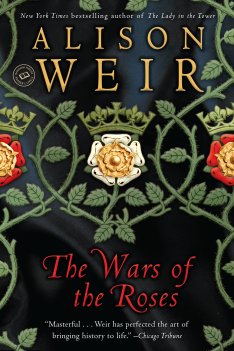 The Wars of the Roses was a series of wars from 1455 until 1487 for the throne of England. It is traditionally taught that it was between the houses of York and Lancaster, yet there were a lot more players involved than these two families. In fact the conflict started much earlier with the children of Edward III and Philippa of Hainault. The Lancasters were the descendants of John of Gaunt and his wife Blanche of Lancaster while the Yorks were descendants of Edmund of Langley Duke of York. This was a series over the question of who had the strongest claim to the throne. This question and the series of wars that would try to answer it is explored in depth in Alison Weir’s book “The Wars of the Roses”.
  The story of Elizabeth I is full of twists and turns. From the moment she was born, she had to fight to survive. Through all that she went through, Elizabeth found the strength and courage to become the legendary queen to help England to enter into a golden age of peace and prosperity. This, however, is just one side of Elizabeth. The other side of Elizabeth’s personality, her anger and her interactions with her councilors, is explored thoroughly in Carolly Erickson’s book “The First Elizabeth”.
  Elizabeth I was perhaps the most influential monarch in English history. There are episodes in her life that became legendary. From her tumultuous childhood to her reign where everyone either wanted her to marry or put someone else on the throne, Elizabeth’s life was hardly easy. Even though much is known about her public life as queen, we really do not know a lot about her private life. In Alison Weir’s book, “The Life of Elizabeth I”, the gap between the public Elizabeth and the private Elizabeth is bridged in order to give a more complete biography of this fascinating English queen.
 Adventures of a Tudor Nerd