
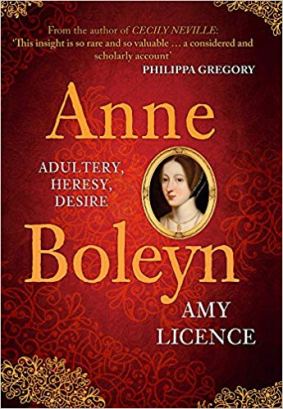
 Anne Boleyn, the second wife of Henry VIII and the mother of the future Queen Elizabeth I, is one of the unique characters of the Tudor era. She was the sister of one of the king’s mistresses, Mary Boleyn, which she could have been, but Henry wanted Anne as his queen. Unfortunately, he was married to his first wife, Catherine of Aragon. It is Henry’s divorce to Catherine and his relationship with Anne, the rise and fall, is what many people look at, but there is more to Anne’s story than just her life with Henry. What was Anne’s life really like and what really caused her fall? These are just a few questions that Amy Licence tackles in her latest biography, “Anne Boleyn: Adultery, Heresy, Desire.”
I would like to thank Amberley Publishing for sending me a copy of this book to review. I haven’t read many biographies about Anne Boleyn so this was a unique experience.
In her introduction, Amy Licence explains her approach to Anne’s life and why she is such an interesting figure to study:
Anne’s is very much a Tudor story, a narrative that balances on the cusp of old and new, equally informed by both. It has been told many times before, but what this version aims to offer afresh is a sense of continuity with earlier Boleyn generations. She was born into an ambitious dynasty, with each generation taking a step forward in terms of career and martial advancements…. That she was the most successful Boleyn cannot be disentangled from her gender and class. By the definitions of her time, Anne was an overreacher in more than one sense. She was a woman, born to be a wife, but not that of the king. She was an aristocrat, descended from the influential Howards, observing but not trained in the demands of queenship. She transcended boundaries of expected behaviour on both counts, which was both her most remarkable achievement and created her two areas of greatest vulnerability. This account of Anne’s life prioritises her relationship with the defining issues of gender and class, tracing their role in her rise and fall. (Licence, 8).
Licence begins her biography by going back to the origins of the Boleyn family, with Anne’s ancestor, Geoffrey Boleyn. Geoffrey came from very humble beginnings, but he worked hard and rose to become the Lord Mayor of London, as well as a knight. His descendants continued this tradition of working hard, which Licence takes the time to explain thoroughly so that the reader can understand that they were not necessarily overreachers; they were hard workers. This background information is extremely helpful to understand the Boleyn family as a whole.
The main focus of Licence’s book is Anne’s relationship with Henry VIII, her husband. By including the letters between Anne and Henry, the reader can see how the relationship started and how their relationship ended in a dramatic fashion. Henry was the one who really took control of the relationship. Anne may have learned how to be a strong woman from working in the French court, but she was no match for Henry VIII.
Although there have been many biographies about Anne Boleyn, this one stands out because Anne is seen in more of a sympathetic light. Licence combines a plethora of details with a writing style that is easy to understand to bring Anne out of the dark side of history. I learned so much about a queen I thought I knew.“Anne Boleyn: Adultery, Heresy, Desire” by Amy Licence was an absolute delight to read. It is a real page-turner and is a must for anyone who loves to read about the Tudors, the wives of Henry VIII, and Anne Boleyn.
 Every family has their own stories. Stories of how they became a family, how they fought hard to get where they are today. Stories filled with love, drama, and endurance. When it comes to royal families, their stories tend to be broadcast to the masses, and none more so than the Tudors, who have captured the imagination of history lovers for generations. The Tudor’s story is often told in parts, focusing on individual people like Henry VIII or Elizabeth I. The Tudor story is fascinating told in parts, but as a whole, one sees how hard they worked to become a dynasty that will be remembered for centuries after their deaths. It is time for the story of this extraordinary family to be told as a whole and Leanda de Lisle does so in her book, “Tudor”.
 The children of Henry VIII have been the center of historical studies for centuries. Edward VI, Mary I, and Elizabeth I were all considered Henry’s “legitimate” children and were able to obtain the crown of England. Henry Fitzroy was the illegitimate son of the king, but he was still able to gain titles and a good marriage before he died. They all had something in common; they were all recognized by their father, Henry VIII. However, there was another child who many believed to have been the daughter of the king. The name of this intriguing lady was Lady Katherine Knollys and her story comes to life in Sarah-Beth Watkins’ book, “Lady Katherine Knollys- The Unacknowledged Daughter of King Henry VIII”.
 Henry VIII, the king who was notorious for his six marriages. His first three marriages, to Catherine of Aragon, Anne Boleyn, and Jane Seymour, gave Henry VIII his only children that were considered eligible for succession. Catherine of Aragon was his first foreign bride, but he would divorce her to marry Anne Boleyn. Anne Boleyn would later be executed and Jane Seymour would die after giving birth to Henry’s son Edward. Henry wanted to marry again, so his most trusted advisors decided to try for a foreign alliance as well as a new bride for the king. They decided that Anne of Cleves from Germany would be the perfect bride, but it did not work out and Henry decided to divorce her and claim Anne as his “sister”. She is often viewed as Henry’s “lucky wife”, but who was she and what was her life like before and after she met her husband Henry VIII? That is exactly the question that Sarah-Beth Watkins wanted to explore in her latest book, “Anne of Cleves: Henry VIII’s Unwanted Wife”.
 Henry VIII’s wives were some of the most fascinating women of the Tudor Dynasty. Katherine of Aragon, Henry’s first wife, the mother of Mary I, and the first wife Henry divorced. Anne Boleyn, the mother of Elizabeth I and the first English queen to be executed. Anne of Cleves, the wife Henry did not like and divorced. Katherine Howard, the second wife Henry executed, and Katherine Parr, the wife who outlived Henry. All of these women were unique, however, there was only one who gave Henry the son that he so desperately desired. Her name was Jane Seymour. Her death was well documented since she died shortly after giving birth to Edward, yet we really don’t know who she was or what her life was like. Alison Weir decides to explore Jane’s life in her third book of the Six Tudor Queens series, “Jane Seymour: The Haunted Queen”.
  The Boleyn family is one of the most notable families during the reign of the Tudors. When one thinks about this family, people like Anne Boleyn, Thomas Boleyn, and George Boleyn come to mind. However, another Boleyn and her family story have been emerging from the shadows of history in recent years. That is the story of Mary Boleyn, a mistress of King Henry VIII. Mary Boleyn had a daughter named Catherine Carey, who married Sir Francis Knollys and was the mother of 14 children, including Lettice Knollys. Since Catherine Carey was a direct relation to the Tudors, what might have her life have been like? Adrienne Dillard wanted to give readers a possible view of Catherine Carey’s life in her book, “Cor Rotto: A Novel of Catherine Carey”.
  After the death of Henry VIII and Edward VI, there was an explosion of religious intolerance, not just in England, but in Europe as a whole. Many believe that it was Mary I “Bloody Mary” who really started this trend, however, the fires of hatred between Protestants and Catholics extended further into the reigns of Elizabeth I and James I of England. We often focus on the monarchs and their inner circles during this time and how the religious persecutions affected the decisions that they made. That tells only part of the story, but how did this religious fighting between Protestants and Catholics affect the normal person? What were their lives like? Ken Follett explores this topic in his third book in his historical fiction series, the Kingsbridge Series, “A Column of Fire”.
  Henry VIII is one of the most notorious kings who ever ruled England. He had six wives, two of which were executed, three legitimate children who would change England forever, and he decided to break from Rome and create his own church. Henry was such a larger than life figure, yet when it comes to historical fiction, he tends to play a smaller part in books about his six wives and is often portrayed as a villain. Henry doesn’t get to have his own voice, in historical fiction, on some of the most important parts in his life, so Margaret George decided to give him one in her book, “The Autobiography of Henry VIII: With Notes by His Fool, Will Somers,” to explain what could have been going on in his mind during these pivotal moments.
 Queen Elizabeth I, “the Virgin Queen”, was the daughter of King Henry VIII and his second wife Anne Boleyn. She was the step sister to Edward VI and Mary I. Her story is full of so many twists and turns, starting from the very beginning, that it is almost a miracle that she lived and became queen. So what type of trials and tribulations did Elizabeth go through to become one of the most successful rulers in English history? What was her life like? Anne Somerset decides to explore these questions, and more, in her book, “Elizabeth I”.
  Adventures of a Tudor Nerd