Guest Post: “Between Two Kings: Book One in the Anne Boleyn Alternate History Trilogy” Q & A by Olivia Longueville

Today, I am pleased to welcome Olivia Longueville back to my blog to discuss her latest novel, “Between Two Kings: Book One in the Anne Boleyn Alternative History Trilogy”. 

B2K cover_page_jpgAuthor Q&A

Anne Boleyn has been featured in many books, movies, and television shows.  Her story has been told by writers many times.  How is your historical fiction series different?

In my first book, Between Two Kings, I re-imagined the life of Anne Boleyn, the second wife of King Henry VIII of England. When I think about Anne and her tragic fate, I want to rescue her from execution on trumped-up charges of adultery, high treason, and incest. Every time I visit the Tower of London, I see the place where she was executed, and I imagine that if I had been in the crowd watching her unjust death, I would have shouted, “Stop it! She is innocent!” 

As a result of my fascination with Anne and her tragic life, I decided to write an alternate history novel about her where she does not die on the 19th of May 1536.  Between Two Kings is part one of my exciting series that reimagines Anne Boleyn’s story in a unique way: having narrowly escaped her execution, she becomes the Queen of France.  In a sense, Anne follows in Eleanor of Aquitaine’s footsteps.  

My writing style is characterized by lush romanticism and passionate lyricism with beautiful and compact descriptions. In this series, I’m working to re-create the cultural atmosphere of the Renaissance and Tudor eras (my favorite periods!), giving my readers a strong sense of place to let them make the imaginative leap into these captivating times. 

This series will appeal to you because this story is about a one-of-a-kind medieval woman, who excelled in a man’s world, and whose fate has been transformed into something utterly spectacular.  Over the course of the novel, Anne emerges as a great Renaissance queen, whose indomitable nature refuses to surrender and enables her ascent to power again.  

Perfect for fans of Alison Weir, Philippa Gregory, Judith Arnopp, Laura Andersen, Tony Riches, and other Tudor authors, as well as fans of movies and shows of the Tudors. 

Are there sequels to Between Two Kings? 

In the second book, The Queen’s Revenge, Anne perseveres in her quest for justice and vengeance on the narcissistic, homicidal King Henry.  Her odyssey takes Anne from a world of gloom, across the barren landscape of ruin and the tempestuous waters of peril, to a realm of potential happiness in her marriage to the flamboyant, chivalrous King François.  Meanwhile, politics and disquieting intrigues abound… 

The later sequels explore deadly plots against Queen Anne and King François, including those of Anne’s Catholic enemies. The Valois couple struggle and intrigues against Emperor Charles V and King Henry VIII are woven into their story, for the English monarch will try to exact his own vengeance on his former wife. This culminates in a war of kings with unexpected participants. King Henry’s marriages to his historical wives have their own interpretation. Charles V’s union with Isabella of Portugal might not have an outcome as tragic as the one in history.

Beyond its theme of vengeance, The Queen’s Revenge is an optimistic tale of good triumphing over adversity and of Anne finding new love and building a life in France.  The third book, The Boleyn Queen of France, is the tale of Anne’s life in France after everyone in Europe learns the identity of the mysterious French queen. It also explores how she grows into her new role as a French queen. The political background of the story is organically embedded into the romantic and suspenseful storyline.   

Do any of the books in the series end in cliff-hangers? Are the books stand alone?  

I’ve structured the trilogy so that the books end with exciting, pivotal moments. I created a sense of completion in Between Two Kings. Although The Queen’s Revenge concludes the plotline of Anne’s vengeance, it includes a political cliff-hanger centering on themes that will be developed and resolved in the third book.  

Enough information is provided in every book, so a new reader will not be lost. 

What is important for writers to create a plausible alternate history reality? 

I love history because it shows how people lived in a completely different world. It reveals something new about the world, people, human evolution, traditions, and the way of life in different periods of time.  Nevertheless, I often wish to explore history from new angles and to re-imagine events or fates of my favorite historical figures. What if certain events had never happened or had occurred in a different way? 

It is a challenge to imagine and construct a plausible alternate history reality. You have to take real historical events and people, analyze them meticulously, and think how events could have unfolded differently, and how people would have responded to altered circumstances. If you like alternate history, you will definitely adore my alternate history universe. 

Many are aggrieved with the unjust end of Anne Boleyn’s life. She was most certainly innocent of all the accusations leveled against her, and our hearts weep at the thought of her last days in the Tower of London and how she lost everything, even her life. In my series, I’ve created an alternate universe for Anne that includes the Tudor, Valois, Habsburg, and even Medici storylines, combining them in a plausible way. 

I hope you will join me as we reimagine the fate of one of history’s most intriguing woman. 

Blurb

Anne Boleyn is imprisoned in the Tower of London on false charges of adultery, high treason, and incest on the orders of her husband, King Henry VIII of England. Providence intervenes – she escapes her destined tragedy and leaves England. Unexpectedly, she saves King François I of France, who offers her a foolhardy deal, and Anne secretly marries the French monarch.

With François’ aid, she seeks vengeance against the English king and all those who betrayed her and designed her downfall in England. Henry must face the deadly intrigues of his invisible enemies, while his marital happiness with his third queen, Jane Seymour, is lost and a dreadful tragedy also strikes the king. The course of English and French history hangs in the balance.

From the gloomy Tower of London to the opulent courts of England, France, and Italy, brimming with intrigue and danger – Anne Boleyn survives, becoming stronger and wiser, and fights to prove her innocence. Her hatred of Henry is inextricably woven into her existence.

If you are interested in “Between Two Kings”, you can purchase it either on Amazon or Amazon UK by clicking on the following links: 

https://bit.ly/Between2Kings

https://bit.ly/Between2Kings-UK

About the Author- Olivia Longueville

Olivia has always loved literature and fiction, and she is passionate about historical research, genealogy, and the arts.  She has several degrees in finance & general management from London Business School (LBS) and other universities.  At present, she helps her father run the family business.  

During her first trip to France at the age of ten, Olivia had a life-changing epiphany when she visited the magnificent Château de Fontainebleau and toured its library.  This truly transformed her life as she realized her passion for books and writing, foreshadowing her future career as a writer.  In childhood, she began writing stories and poems in different languages.  Loving writing more than anything else in her life, Olivia has resolved to devote her life to creating historical fiction novels.  She has a special interest in the history of France and England.  

Olivia’s social media profiles:

Personal website: http://www.olivialongueville.com/

Project website: http://www.angevinworld.com/

Twitter: @O_Longueville
Facebook: http://www.facebook.com/OliviaLongueville/

Tumblr: http://www.olivia-longueville.tumblr.com/

Book Review: “1520: The Field of the Cloth of Gold” by Amy Licence

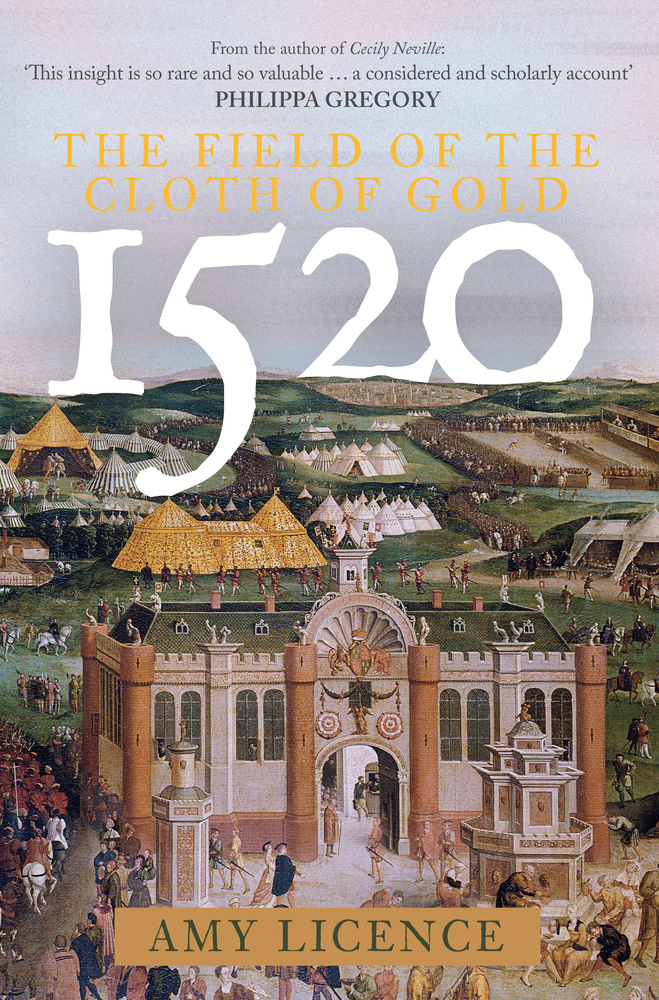
48849570In 1520, two larger than life kings met each other in France for two weeks. This may not sound astounding as many kings left their respected countries to meet other rulers throughout history. It was part of European diplomacy. However, what made this particular period of time extraordinary is the sheer size and the opulence of the event. The King of England, Henry VIII, met the King of France, Francis I, for two weeks of festivities and feasting that we now call The Field of the Cloth of Gold. We often think that this event accomplished nothing because the rivalry between Henry VIII and Francis I continued afterward. Was the purpose of this event to quell the rivalry between the two kings or was there something more behind all the glitz and glam of the Field of the Cloth of Gold? What do the behind the scenes records reveal about this event? Amy Licence explores this event from every angle in her latest book, “1520: The Field of the Cloth of Gold”.
I would like to thank Amberley Publishing for sending me a copy of this book. When I heard about this book from Amy Licence, I knew that I wanted to read it. Since 2020 marks the 500th anniversary of the Field of the Cloth of Gold, it seemed extremely appropriate to read this book in 2020.

To understand why Henry VIII and Francois I met each other, Licence includes brief biographies of these two dynamic figures and the women that accompanied them to the field in France. Obviously, the information about Henry VIII and his wife Katherine of Aragon was a review for me, but I found the biographies of Francis I and his wife Claude quite fascinating. The relationship between the two kings shaped why this event took place. Licence explains the political negotiations that took place to make such an event happen. She also takes the time to show the role that a third party, Emperor Charles V, took in the timing of the event.

The bulk of this book is the grand event itself. Licence’s attention to detail is meticulous and readers can tell her passion for this subject. What I knew about the Field of the Cloth of Gold before reading this book was an overview of the event, which is why I appreciate the attention to detail in this book. Licence uses letters and descriptions from those who were able to attend this event to show the vast scale of each day. From jousting to feasts, balls, and masques, there was so much symbolism and revelry to be had by all. To pull off a spectacle such as this on both sides, it was the craftsmen, the cooks, and the temporary villages of people who made these two weeks a sensation. Licence shows how much planning and how expensive it was to throw a party of this magnitude and what impact it had on political decisions after the pavilions and temporary palaces went down.

I found myself thoroughly enjoying the intricate details that Licence included with her stylistic yet readable writing style. Licence made her readers feel like they had a front-row seat to the Field of the Cloth of Gold while being academic and very well researched. I found myself imagining the splendor of those two weeks. If you want a tremendous book on this extravaganza of 16th-century European grandeur, I highly recommend you read, “1520: The Field of the Cloth of Gold” by Amy Licence.

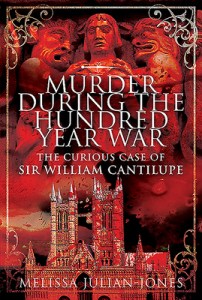
Book Review: “Murder During the Hundred Year War: The Curious Case of Sir William Cantilupe” by Melissa Julian-Jones

In 1375, the body of Sir William Cantilupe was found murdered in a field. He was stabbed multiple times, yet it looked like he was moved as his clothing had no marks on it. The initial investigation pointed to William Cantilupe’s immediate family and his household staff who appeared dissatisfied with how he ran his household. This particular case has been an area of fascination for medieval historians for centuries as it explores different aspects of life during the Hundred Years War. Some of these areas include domestic violence, social norms, law and order, and the punishment for crimes like murder. Melissa Julian-Jones explores every aspect of this case while combining contemporary sources to give readers a new approach to this murder in her book, “Murder During the Hundred Year War: The Curious Case of Sir William Cantilupe”.
I would like to thank Pen and Sword Books and NetGalley for sending me a copy of this book. I had never heard of this case, but after reading the Shardlake series, I was looking for another historical who done it. When I heard about this book, I thought I would give it a try.

Julian-Jones introduces her readers who may not be familiar with this case to the basic facts; when the sheriff and the coroner discovered Sir William Cantilupe’s body in a ditch in a field, which was not that uncommon for a medieval murder. At first, they assumed that it was a simple case of a highway robbery, which Julian-Jones does explore for a bit, but they quickly come to the conclusion that the murder occurred inside of his own household.

To explore the motives of those who might have killed William, which included his wife Maud and his household staff, Julian-Jones explores the family history of the Cantilupes and why people might have wanted to kill William. This part of the book was a bit difficult to read because she does not mince words when it comes to some of the graphic details of their lives, which includes elements of domestic violence. Sometimes when you do study history, you will confront things in history that will make you feel uncomfortable, but it is part of the learning experience to know that things in the past were not always black and white, there were a lot of grey areas.

Julian-Jones spends the bulk of her book exploring the lives of those who were considered the suspects of the murder. Since we don’t have much information about their particular lives because of their stations in life, Julian-Jones had to rely on similar cases from the same era to show what the motive might have been and what the punishment for the crimes was for the different stations of life. This was quite fascinating as we see how a medieval historian who studied criminal accounts had to act like a detective to figure out what the truth might have been and who might have committed the murder.

Julian-Jones takes her readers on a medieval murder mystery ride that affected the nobility, rather than the nobility, which is rather unusual. This book will expand your knowledge about the medieval nobility, their households, and the criminal justice system of their time. This was truly a fascinating study into a centuries-old cold case mystery. If you want a good study into a medieval mystery, you should definitely check out, “Murder During the Hundred Year War: The Curious Case of Sir William Cantilupe” by Melissa Julian-Jones.

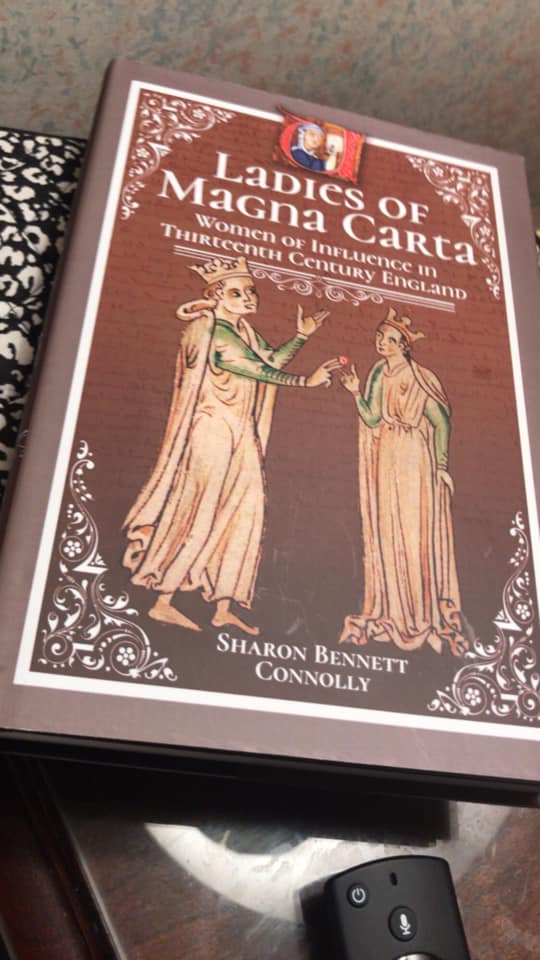
Guest Post: Women and the Birth of Magna Carta By Sharon Bennett Connolly

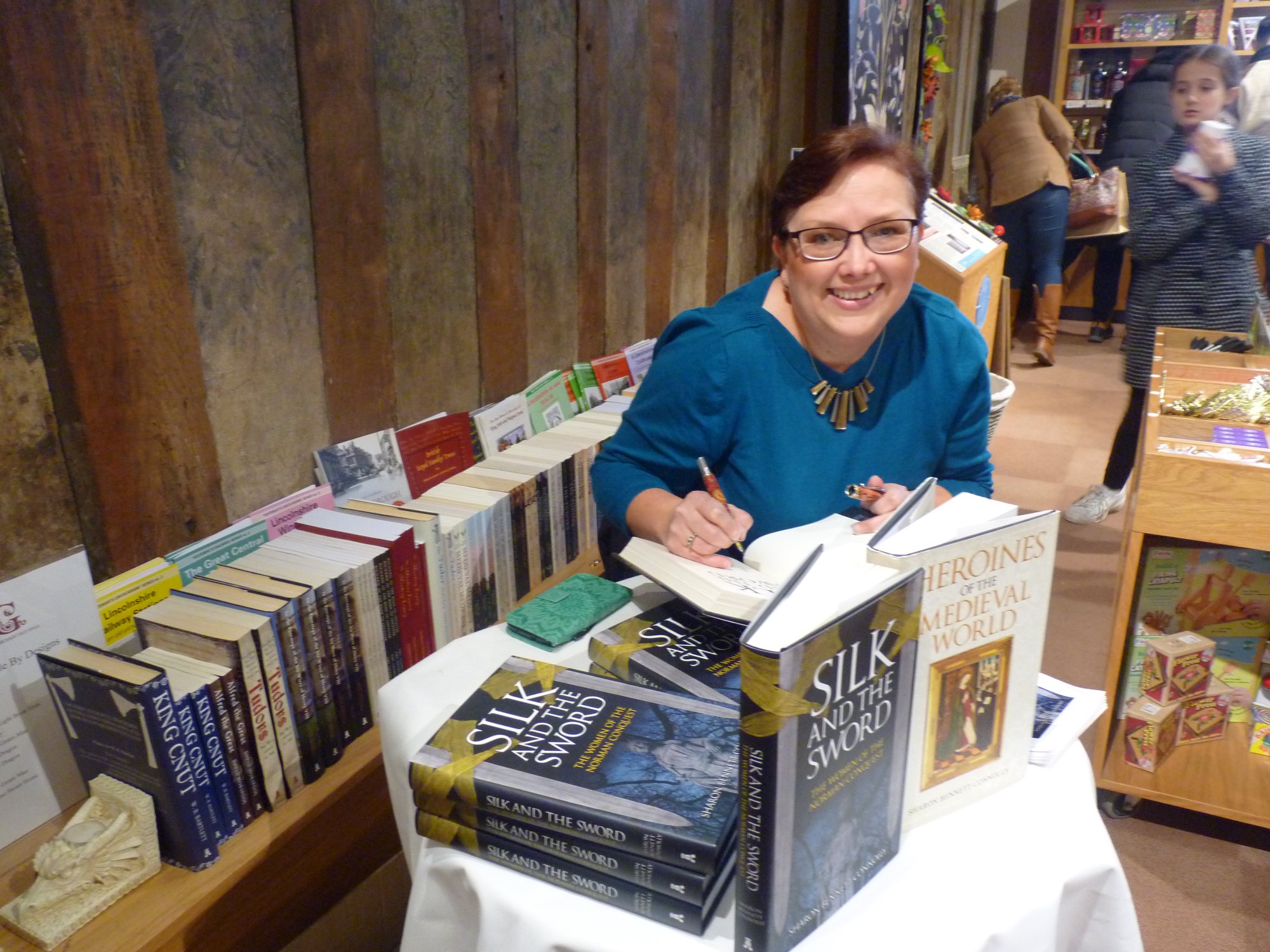
118040039_3243809485697736_4753222466893410523_nToday, I am pleased to welcome Sharon Bennett Connolly, the author of Ladies of Magna Carta: Women of Influence in Thirteenth Century England. She will be discussing the Magna Carta and the women who influenced this extraordinary document.
Magna Carta is probably the most significant charter in English history and,
today, its importance extends beyond England’s shores, holding a special place in the constitutions of many countries around the world. Despite its age, Magna Carta’s iconic status is a more modern phenomenon, seen in the
influence it has had on nations and organizations around the globe, such as the United States of America and the United Nations, who have used it as the basis for their own 1791 Bill of Rights and the 1948 Universal Declaration of Human Rights, respectively.

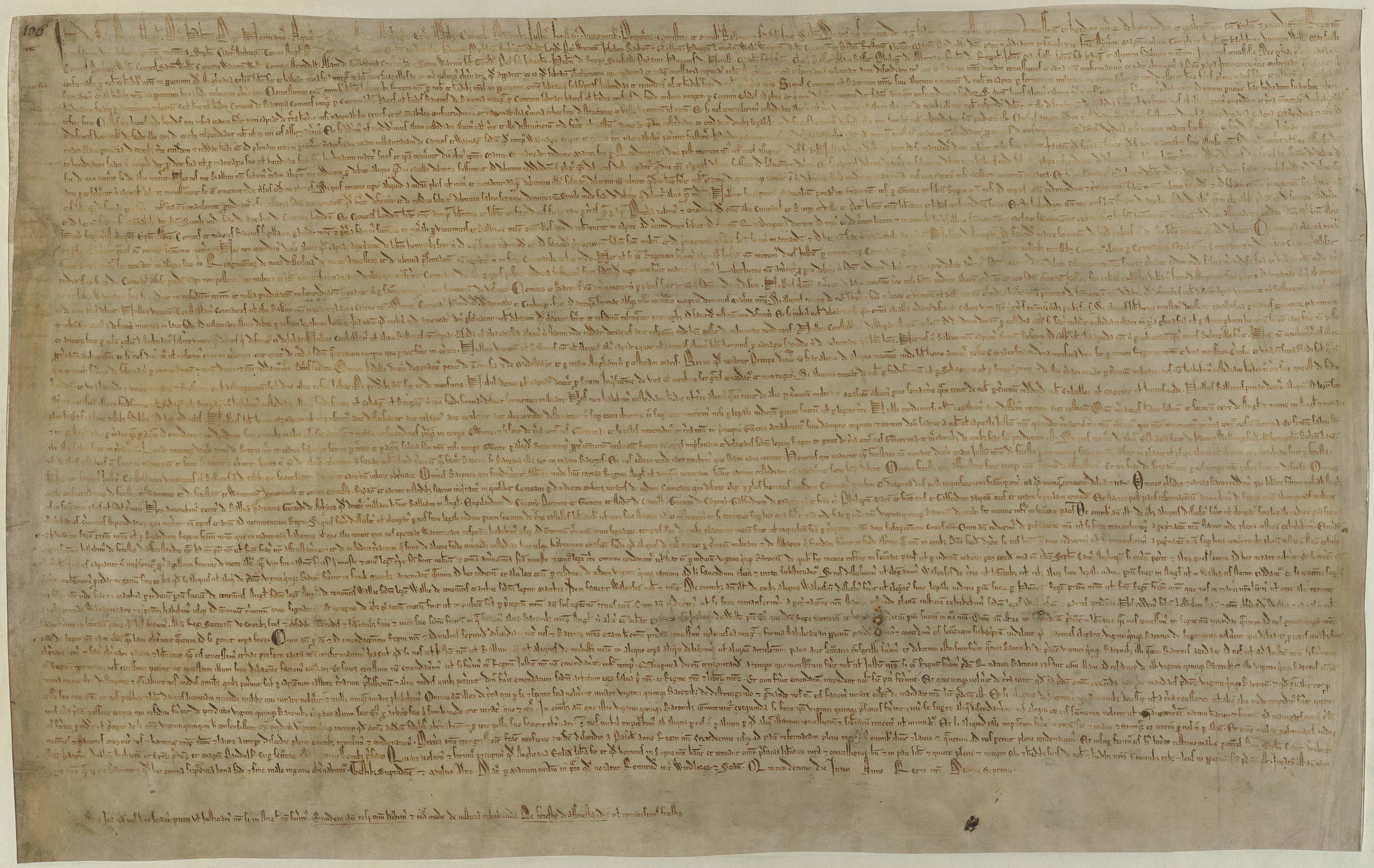
After more than 800 years, there are only four original copies of the 1215 charter remains in existence. The best preserved of these four is thought to have arrived at Salisbury Cathedral within days of it being issued on 15 June 1215 and is housed in an interactive exhibition in the cathedral’s Chapter House. A second is owned by Lincoln Cathedral and is now housed in a new, purpose-built, state-of-the-art underground vault in the heart of Lincoln Castle. The remaining two are owned by the British Library in London, one of which was badly damaged by fire in 1731 and has deteriorated over the years; however, the other is on display in the Treasures exhibition, a magnet to visitors from all over the world, who wish to see the iconic Magna Carta.

4

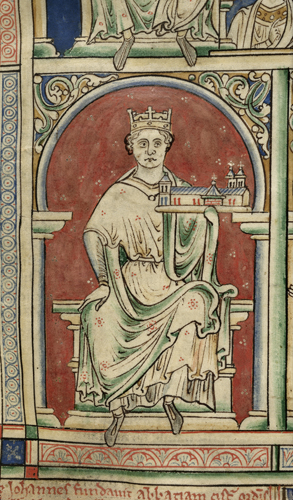
Originally called the Charter of Liberties, it was renamed Magna Carta or Great Charter, in 1217, when the Charter of the Forest was issued. Sealed (not signed) in the meadow at Runnymede in June 1215, the legacy of Magna Carta, down through the centuries, has enjoyed a much greater impact on history and the people of the world than it did at the time of its creation. As a peace treaty between rebellious barons and the infamous King John, it was an utter failure, thrown out almost before the wax seals had hardened, not worth the parchment it was written on. The subsequent armed rebellion saw a French prince invited to claim the English throne – if he could wrest it from John’s hands – and John spent the last year of his life clinging desperately to his crown and lands.

Royal 14 C.VII, f.9

Just fifteen months after Magna Carta was sealed, King John was on his deathbed; he died in his forty-ninth year, at Newark Castle on the
night of 18/19 October 1216. His 9-year old son, Henry III, inherited a country mired in a civil war, with half of it occupied by a French army. The young king and his regent, William Marshal, Earl of Pembroke, had a fight on their hands; they wasted no time in reissuing the Magna Carta and setting about regaining control of the country.

Essentially a peace treaty, Magna Carta is the closest thing England has to a
constitution. It addressed the worries and grievances of the English nobility,
the barons, and sought to curb the powers of the king, firmly placing the
monarch below the law, rather than above it. But what of the women? A small number of Magna Carta clauses were influenced by the experiences of women or sought to protect the rights of women.

Of the sixty-three clauses, two stand out as the guarantors of liberty and the
law, not only in England but around the world. Clause 39 ensures that ‘no man shall be taken or imprisoned or deprived or outlawed or exiled or in any way ruined, nor will we go or send against him, except by the lawful judgment of his peers or by the law of the land.’ This guarantee of justice for all is believed to have been inspired by John’s treatment of Matilda de Braose, wife of William de Braose, Lord of Bamber. William was one of John’s foremost supporters in the early years of his reign, but later fell afoul of the king and saw his family hunted and hounded, almost to destruction. This clause is supported by the one following, clause 49, which states categorically; ‘To no one will we sell, to no one will we deny or delay right or justice.’

As a consequence of John’s rancor poor Matilda and her son, also called
William found themselves languishing in one of John’s prisons. King John
made an agreement with both William and Matilda; freedom for her and a
pardon for William in return for 40,000 marks. However, being either unwilling or unable to pay, Matilda and her son remained in prison – either at Windsor or Corfe Castle – and William was outlawed, eventually escaping into exile in France, disguised as a beggar, where he died in 1211.

Matilda’s fate was more gruesome; she and her son were left to starve to
death in John’s dungeons (though whether this was at Corfe or Windsor is
unclear). Tradition has it, that when their bodies were found, William’s cheeks bore his mother’s bite marks, where she had tried to stay alive following his death:

‘On the eleventh day the mother was found dead between her son’s legs, still
upright but leaning back against her son’s chest as a dead woman. The son,
who was also dead, sat upright, leaning against the wall as a dead man. So
desperate was the mother that she had eaten her son’s cheeks. When William
de Braose, who was in Paris, heard this news, he died soon afterwards, many
asserting that it was through grief.’ (Anonymous of Bethune)

9

The Magna Carta of 1215 reflects the needs and events of the time in which it was issued; an England on the brink of civil war, disaffected barons demanding redress, the church and cities, such as London, looking for protection. It was drawn up by barons looking for reparations and legal protection from a king whose word could no longer be trusted, who meted out arbitrary punishments and heavy taxes. It was not a charter that was intended for the protection and legal rights of every man, woman and child in the land; though it has come to be seen as just that in subsequent centuries. Indeed, the common man does not get a mention, and of the sixty-three clauses, only eight of them mention women as a gender.

Only one clause uses the word femina – woman – and that is a clause which
restricts the rights and powers of a woman, rather than upholding them.
Clause 54 states: ‘No one shall be taken or imprisoned upon the appeal of a
woman for the death of anyone except her husband.’ At first glance, this has to be the most anti-feminist statement ever made, a woman was not allowed to give evidence of a murder unless it was her own husband who was killed. However, the barons believed they had justification for inserting this clause. In a time when a man had the right to face his accuser in trial by combat to prove his innocence, this right would be automatically removed if his accuser was a woman; women were not allowed to use force of arms. A female accuser was seen as being able to circumvent the law, and therefore the law was open to abuse. It was not just that a woman may bear false witness and the accused would have no right of redress in battle; it was also that a woman may be manipulated by her menfolk to make an accusation, knowing that she would not be required to back it up by feat of arms. Whereas her husband, father or brother may have been challenged to do just that.

However, while it is possible to see why this clause was written, it does not
deny the fact that women were treated so differently and denied the
fundamental right to justice simply because of their gender. This very clause was used on 5 July 1215, when King John ordered the release of Everard de Mildeston, an alleged murderer. Everard had been accused of the murder of her son, Richard, by Seina Chevel. Such a charge was now forbidden under the terms of Magna Carta, and the accused was therefore released. It is, of course, true that many of the clauses of Magna Carta refer to people in general, rather than just men, and that women are included in such clauses, as well as in the eight which refer to them specifically. However, the significance of women in the Magna Carta story is not just their limited inclusion in the charter itself, but also in their experiences of the unsettled times in which they lived, in their influence on the charter and in their use of its clauses to exact recompense for injustices they have experienced.

3

The political crisis which saw the issuing of Magna Carta, and the civil war which followed, was not just significant to the barons involved, but to their wives and families, tenants and retainers. The conflict tore families apart as they took sides in the struggle and saw more than one baron change sides mid-crisis. Wives and daughters were caught in the middle, often torn by divided loyalties; between their birth family and the family into which they had married; between their fathers and their husbands. For instance, Matilda Marshal was the eldest daughter of William Marshal, a man known for his staunch loyalty to the crown, but she was married to Hugh Bigod, son of Roger, second Earl of Norfolk, one of the leaders of baronial opposition; Roger and Hugh were both named among the twenty- five barons appointed to ensure that John adhered to the terms of Magna
Carta, known as the Enforcers of Magna Carta.

Some of the clauses are specific to the people on the political stage in 1215.
Clause 59 of Magna Carta, for instance, refers to two particular women,
though they are identified by their relationship to the king of Scots, rather than their names. These were two of the sisters of Alexander II, who had been held hostage by King John since the 1209 Treaty of Norham. John had promised to find husbands for the two princesses, preferably within the royal family. However, the marriages had never materialized and, six years on, the young women, Margaret and Isabella, were now in their twenties, and still unmarried. The Magna Carta clause opens with; ‘We will treat with Alexander, king of Scots, concerning the return of his sisters and hostages…’
As with many of the issues addressed in Magna Carta, the problem of the
Scottish princesses was not resolved immediately. Margaret was eventually
married, in 1221, to King Henry III’s justiciar, Hubert de Burgh; a lowly marriage for the daughter of a king. Isabella, however, remained unmarried and in 1222 returned to Scotland. She was eventually wed to Roger Bigod, 4th Earl of Norfolk, in 1225. Roger was the son of Matilda Marshal and therefore grandson of William Marshal, Henry III’s regent. At only 13 years of age, young Roger was still a minor and with an age disparity of around 17 years, the marriage was not a happy one. The couple never had children and Roger tried to have the marriage annulled at one stage but was refused by the church.

These are just a handful of examples of how the lives of women are woven into the Magna Carta story. The deeper you dig, the more fascinating stories you will find. Magna Carta started England on the road to democratic government and, more importantly, universal suffrage, culminating in votes for women in 1918. Magna Carta was the first step. Within a generation of the charter’s first issue, women such as King John’s own daughter, Eleanor de Montfort, were helping to fight for political reform and others, such as Isabel d’Aubigny, were using its clauses to their advantage. Women had been a part of the fight for and against King John in the lead up to the first issuing of Magna Carta. They had influenced its creation and continued to use its clauses to fight for their rights and those of their families. There was still a long way to go, especially for women. Magna Carta was not the start of the women’s rights movement, but
it serves as a benchmark for how far society has come in the last eight
centuries.

Photo information:

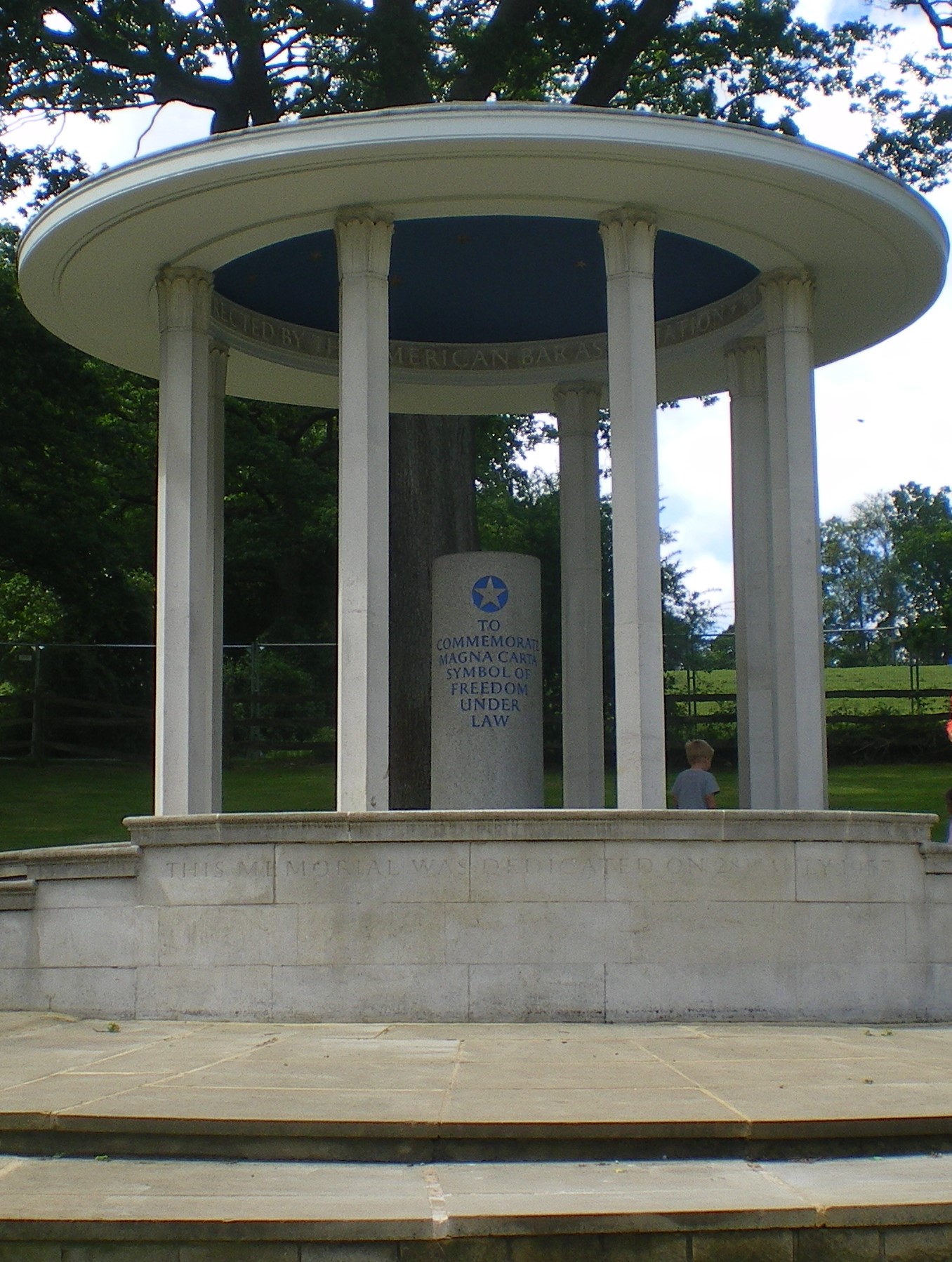
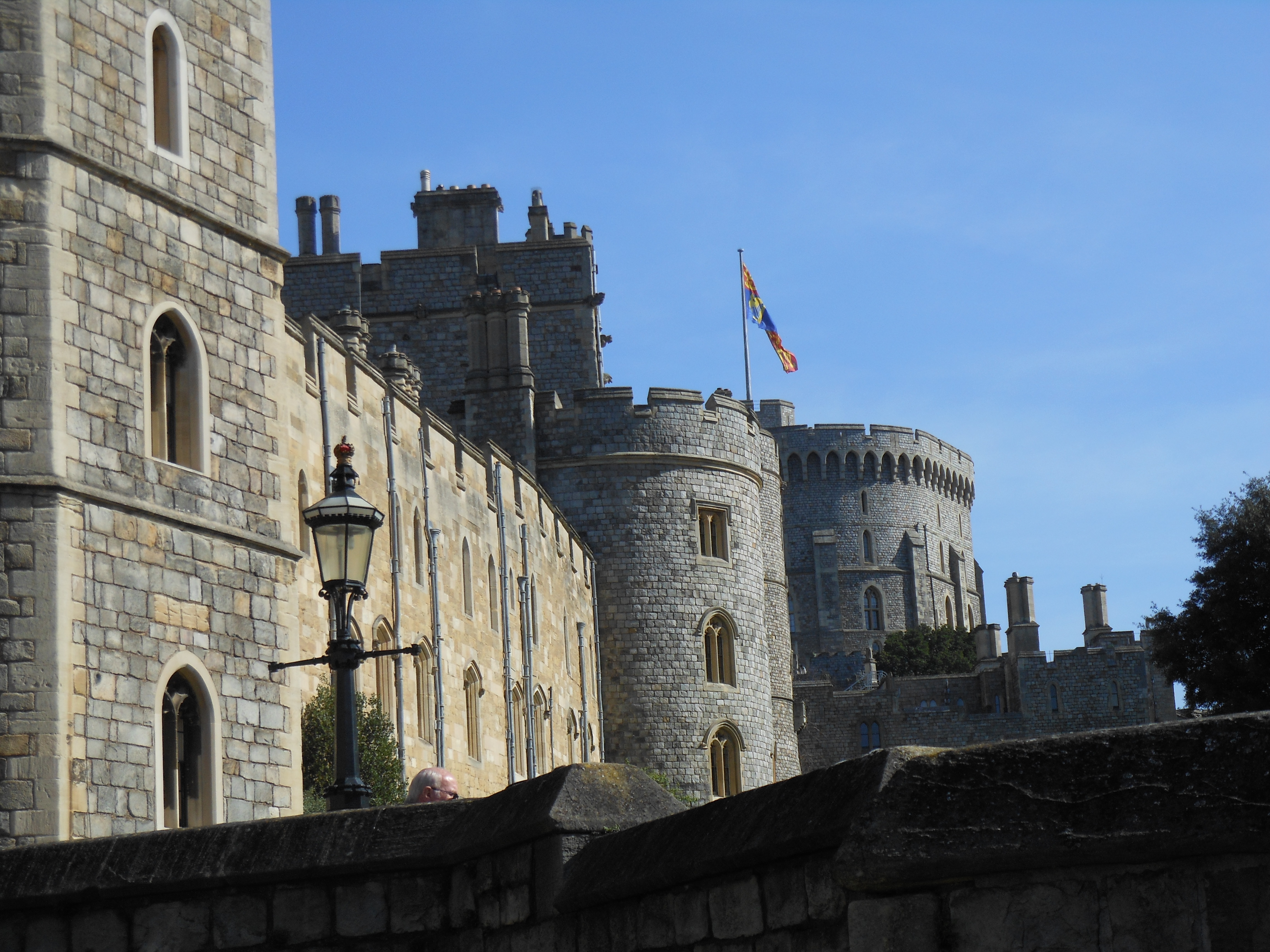
Ladies of Magna Carta; the Magna Carta (British Library); Magna Carta memorial, Runnymede (Jayne Smith); King John (British Library); Windsor Castle, possible location for the sad death of Matilda de Braose and her son William (my photo).

Author bio:

Sharon Bennett Connolly
Sharon Bennett Connolly has been fascinated by history her whole life. She
has studied history academically and just for fun – and even worked as a tour guide at historical sites. For Christmas 2014, her husband gave her a blog as a gift – http://www.historytheinterestingbits.com – and Sharon started researching and writing about the stories that have always fascinated, concentrating on medieval women. Her latest book, Ladies of Magna Carta: Women of Influence in Thirteenth Century England, released in May 2020, is her third non-fiction book. She is also the author of Heroines of the Medieval World and Silk and the Sword: The Women of the Norman Conquest. Sharon regularly gives talks on women’s history; she is a feature writer for All About History magazine and her TV work includes Australian Television; Who Do You Think You Are.

Links:
Blog: https://historytheinterestingbits.com/
Facebook: https://www.facebook.com/Thehistorybits/
Twitter: @Thehistorybits
Instagram: https://www.instagram.com/sharonbennettconnolly/?hl=en
Amazon: http://viewauthor.at/SharonBennettConnolly

Pen & Sword: https://www.pen-and-sword.co.uk/Ladies-of-Magna-Carta-
Hardback/p/17766

Book Review: “Joan, Lady of Wales: Power and Politics of King John’s Daughter” by Danna R. Messer

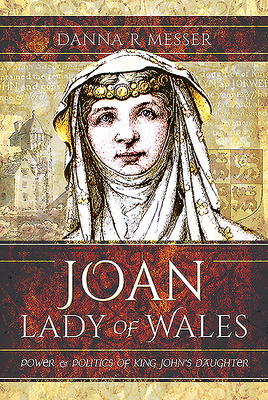
51351935Medieval women held many different titles that defined their roles and their connections. Mothers, daughters, and wives tended to be the most popular and the most common. Titles such as queen, political diplomat, and peace weaver tend to be rare and given to women of power. Yet, these words accurately depict a unique woman who lived during the Angevin/ Plantagenet dynasty. She was the illegitimate daughter of the notorious King John and the wife of Llywelyn the Great, a Prince of Wales. She worked tirelessly to establish peace between England and Wales, yet she has not received much attention in the past. Her name was Joan, Lady of Wales, and her story is brought to life in Danna R. Messer’s book, “Joan, Lady of Wales: Power and Politics of King John’s Daughter”.
I would like to thank Pen and Sword Books and Net Galley for sending me a copy of this book. I did not know much about Joan, except what I read about her in Sharon Bennett Connolly’s latest book, “Ladies of Magna Carta: Women of Influence in Thirteenth-Century England”. She sounded really interesting so when I heard about this book by Messer, I wanted to read it to learn more about Joan.

As someone who did not know a lot about Joan or medieval Wales, I found this book informative and enjoyable. Messer takes the time to explain what life was like for a royal Welsh couple, like Joan and Llywelyn, and why their marriage made such an impact in the long run. On paper, it was a princess from England marrying a prince from Wales, but what made this union so unique was the fact that Joan was the illegitimate daughter of King John and yet she was treated like a beloved legitimate child. Of course, this marriage was first and foremost, a political match, but it seemed to have developed into a strong and loving partnership, that endured 30 years of trials and tribulations.

One of the major trials that Joan had to deal with was to prevent England and Wales from going to war against each other. Truly a monumental challenge for, as Messer meticulously points out, Llywelyn and either King John or King Henry III were constantly having disagreements. I could just picture Joan getting exasperated that she had to try to calm things down between England and Wales every single time. Her diplomatic skills were truly remarkable, especially with how much influence she possessed in both countries.

Probably the most controversial event in Joan’s life is her affair with William de Braose, which led to his execution and her imprisonment. Messer does a good job explaining what we know about this situation. Unfortunately, like many events in Joan’s life, Messer has to use a bit of guesswork to try and put together the clues about Joan and figure out what happened. It can be a bit frustrating, but we have to remember that Joan lived over 800 years ago and women were not recorded as detailed as they are now or even 500 years ago. I think we can give Messer a pass on guessing where Joan was and what her role was in certain events.

Overall, I found this book enlightening. I think Messer’s writing style is engaging and she was dedicated to finding out the truth, as far as the facts would take her. I think this is a fantastic book for someone who needs an introduction to medieval Welsh royal lifestyle, the power of royal Welsh women, and of course, a meticulously detailed account of the life of Joan, Lady of Wales. If this describes you, check out “Joan, Lady of Wales: Power and Politics of King John’s Daughter” by Danna R. Messer.

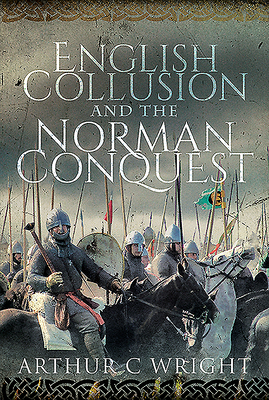
Book Review: “English Collusion and the Norman Conquest” by Arthur C. Wright

51352100 (1)The Norman Conquest of 1066 was one of the most important dates in English and world history. It signaled the start of the Norman influence in England with Duke William, also known as William the Conqueror, becoming King of England. But does William I deserve the reputation that is attributed to him in history, or should we be careful with how we view him because his story is told by the avaricious Church? How much help did William and the Normans receive from their English counterparts? Can we call this event a “conquest”? Who was to blame for the “Harrowing of the North”? These questions and more are discussed in Arthur C. Wright’s latest book, “English Collusion and the Norman Conquest”.

I would like to thank Pen and Sword Books and Net Galley for sending me a copy of this book. When it comes to studying the Norman Conquest, I am a bit of a novice, so I was excited to read another book about this time.

I found this book rather difficult to understand. Wright writes in a style where he is having a conversation to experts, while at the same time saying that every historian has it wrong and he knows exactly what happened. This rubbed me the wrong way. If he had proved his point, I might have found his argument compelling, but he just came off as an angry rambler in the first half of this book. I really wanted to understand what he was trying to say, but I did not see his evidence for English collusion. Instead, he spent a lot of time arguing that feudalism is a myth, which was quite bizarre.

I think the second part of his book was stronger than the first half. It explored the life, commerce, and education of the average citizen. I think if Wright had reorganized his chapters, this book might have been a bit easier to comprehend. Wright tends to focus on after the conquest, without specifying dates, but it is hard to see where the English collusion comes into play. Another problem that I did have is when he tried to insert more modern sayings, ideas, and characters into the conversation. It felt out of place and rather distracting.

I do believe that Wright is knowledgeable when it comes to the subject of the Norman Conquest and England in the years that followed. Unfortunately, his writing style makes it difficult to understand what message he is trying to get across with this particular book. It was readable, but the focus was a bit off and it was hard to figure out his target audience. If you are familiar with the Norman Conquest and would like a challenge, check out “English Collusion and the Norman Conquest” by Arthur C. Wright. It was not my cup of tea, but that does not mean it is a bad book. Someone else might enjoy it.

Book Review: “The Castle in the Wars of the Roses” by Dan Spencer

When one thinks about Medieval Europe and buildings, we tend to focus on the luxurious castles with their impenetrable walls. It is a rather glamorous image, but the problem is it is not accurate. Castles were used for defensive measures to protect the kingdom from attacks, either from outsiders or, in some cases, from within. Medieval warfare and castles go hand in hand, but one conflict where we tend to forget that castles play a significant role is in the civil war between the Yorks and the Lancasters, which we refer to today as The Wars of the Roses. Dr. Dan Spencer has scoured the resources that are available to find out the true role of these fortresses, both in England and in Wales, in this complex family drama that threw England into chaos. His research has been compiled in his latest book, “The Castle in the Wars of the Roses”.

I would like to thank Pen and Sword Books and Net Galley for allowing me the opportunity to read this book. I enjoy studying the Wars of the Roses and when I heard that this book was coming out soon, I knew that I wanted to read it.

To understand this transition that castles and the roles they played during this tumultuous time undertook, Spencer, takes us on a journey from the Norman Conquest to the 1450s. It was informative to see how castles transformed to fulfill different roles over distinct periods.

Spencer’s book shares some similarities with previous books that I have read about the Wars of the Roses in the fact that it does highlight the main battles and the main people who were vital in this conflict. However, Spencer’s book dives a bit deeper into the military aspects of the wars to show what makes this conflict so unique. What makes the Wars of the Roses so fascinating is that, compared to other famous medieval wars, castles were not the central focus for battles. Instead, castles during this period were used for garrisons, headquarters for military commanders, and as tools to show political favor for whoever was on the throne.

The true strength of this particular book is Spencer’s meticulous research and his scrupulous attention to detail. He was able to combine narrative, administrative, financial, military, and architectural records to create an illuminating manuscript that gives an extra layer of depth to the Wars of the Roses. It did take me a while to get used to all of the minor characters and the castles that I had never heard of before, but once I did, it was absorbing. We tend to focus on the major characters during the 15th century, but they would not be as legendary as they are today without the help of countless men who have been forgotten for centuries. The one problem that I did have with this book is a minor issue and that was when he said Henry VII married Elizabeth Woodville, not Elizabeth of York.

Overall, I found this book extremely enlightening. I thought that I knew quite a bit about the Wars of the Roses, but Spencer was able to surprise me with the amount of new information that he included in this tome. It opened a new aspect of this conflict that I never considered before. If you are someone who enjoys studying the Wars of the Roses and medieval castles, “The Castle in the Wars of the Roses” by Dan Spencer is a book that you should include in your collection.

Book Review: “Ladies of Magna Carta: Women of Influence in Thirteenth Century England” by Sharon Bennett Connolly

Pen & Sword Book Cover / Jacket artworkThe year of 1215 marked a turning point in English history with the sealing of a rather unique document; the Charter of Liberties, or as we know it today, the Magna Carta. It was a charter from the people to a king demanding the rights that they believed that they deserved. Those who sealed it were rebel barons who were tired of the way King John was running the country, yet instead of asking for his removal, they wanted reform. The clauses mostly concerned the problems of the men who made the charter, however, three clauses dealt with women specifically. In her latest book, “Ladies of Magna Carta: Women of Influence in Thirteenth Century England”, Sharon Bennett Connolly explores the lives of the women who were directly impacted by this document.

I would like to thank Pen and Sword for sending me a copy of this book. I enjoyed the last book that I read by Sharon Bennett Connolly and so when I heard that this book was going to be released, I knew I wanted to read it. I did not know much about thirteenth-century English history and the Magna Carta, so I was excited to start this new adventure.

To understand why the Magna Carta was considered an essential document for the time that it was forged, Connolly dives into the life of King John. His life and legacy will touch every woman in this book so it is vital to understand how John ran England while he was king. Although Connolly tends to be slightly repetitive with information about John, it is imperative that we as readers understand the significance of this reign and why it led to the Magna Carta, which radically changed English history forever.

Now, when one thinks about women who lived during thirteenth-century England, we tend to think about women whose marriages and bloodlines would interlace the numerous noble families of the time. Though some of the tales follow this pattern, there were some women and families who went against the norm. Women like Matilda de Braose, whose horrific imprisonment and starvation that led to her death, paved the way for clause 39 of the Magna Carta. There were also extremely strong women, like Nicholaa de la Haye, who was England’s first female sheriff and gained power and prestige by her own merits. These women acted as peacemakers by marrying foreign princes, or they were married to rebels against John. And of course, some women knew John well, like his wife Isabella of Angouleme, who had a very negative reputation because of John.

What I enjoyed about this book is how Connolly shared stories from women of many different walks of life. They were all so different and so unique. Connolly’s meticulous research and her true passion for this time paired with her easy to understand writing style make this book an engaging and insightful read. I found this a delightful read. If you want a fantastic book that introduces you to the world of the Magna Carta and the women who directly affected by this charter, I highly recommend you read, “Ladies of Magna Carta: Women of Influence in Thirteenth Century England” by Sharon Bennett Connolly.

Book Review: “Six Tudor Queens: Anna of Kleve, Queen of Secrets” by Alison Weir

44034429._SY475_A foreign princess who travels to England to marry the king to establish a strong political alliance. To those who study history, this is a story that has been told numerous times, but what makes this particular story unique is the people involved. The bridegroom was the recently-widowed Henry VIII, the shadow of his former self and notorious throughout Europe for having his second wife Anne Boleyn executed. His new bride to be is the German princess Anna of Kleve. To say that they did not see eye to eye would be an understatement as the marriage did not last long. Her story is often swept under the rug. Anna is often viewed as the “lucky” wife of Henry VIII, but was she? What was Anna’s story and what was her marriage with Henry really like? Alison Weir has taken up the challenge to give her readers a taste of what Anna’s life might have been like in this novel, “Six Tudor Queens: Anna of Kleve, Queen of Secrets”.
As many of you know, I am a big fan of Alison Weir and I have enjoyed the “Six Tudor Queens” series thus far, so I knew that I wanted to read this one. Anna of Cleves is one of my favorite wives of Henry VIII, yet I have never read a historical fiction novel on her, so I found this concept of this book intriguing.

Weir begins her book with Anna’s life in her native Germany and her relationship with her family. To see her interacting with her parents and her siblings was delightful and so relatable. We even saw them arguing about Catholicism versus Protestantism, which was the hot topic of the time. Anna is informed that she was to marry King Henry VIII of England, who has been married three previous times. Weir takes the time to show Anna’s journey from Germany to England and how she transitioned into her new life in a new country. Her relationship with Henry is more of a close friendship than that of a husband and wife, which is very loving, caring, and believable. I enjoyed her relationships with Henry’s other wives, Katherine Howard and Katherine Parr since there is no animosity between them. Anna’s relationships with Henry’s children are very nurturing, especially towards Mary Tudor, who is more of a best friend relationship rather than a step-mother, step-daughter relationship.

Weir’s focus in this book is truly the relationships of those closest to Anna, but there are a few, in particular, that stands out; Anna’s relationships with her lover and their son. I will say that before I read this book, I knew about this storyline and I was upset about it. However, when I started to read this book, I enjoyed it. Of course, I know it is a fictional storyline, but I have always felt bad for Anna that she never married again after she divorced Henry. She was still in the prime of her life which makes you question if she ever loved anyone. As a work of fiction, I found this storyline compelling, even if it is not for everyone. It added a different element to Anna’s story.

Overall, I found this novel enjoyable and very well written. I truly felt sympathy for Anna with every trial she faced. Since this is a historical fiction novel, some of it should not be taken as factual, but what Weir does extremely well is she created a relatable and loving heroine in Anna. If you want an engaging Tudor historical fiction novel to read, I would recommend you read, “Six Tudor Queens: Anna of Kleve, Queen of Secrets” by Alison Weir.

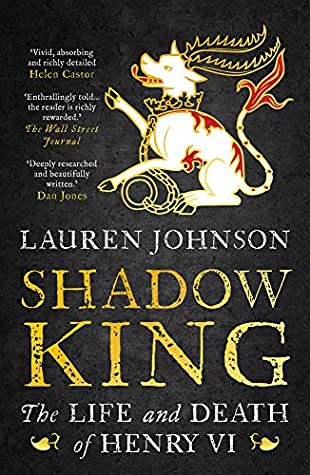
Book Review: “Shadow King: The Life and Death of Henry VI” by Lauren Johnson

50270709._SY475_Medieval kings are often painted as strong, colorful figures in history. They were warriors who fought to protect their families and countries. Often, we tend to think of men like King Henry V and King Edward IV when it comes to the late medieval kings of England. However, there was a man who was sandwiched between these two pillars of strength. He was the son of Henry V, the king who came before Edward IV, and the man who started the conflict known as the Wars of the Roses. Unlike these two men, Henry VI was a pious peacemaker and is often viewed as a mere man in the background who never measured up to the standards his famous father left behind. His story is often incorporated into other biographies of people of his time; Henry VI has not had a solid biography about his life in a long time. That is until now. Lauren Johnson has taken up the challenge of exploring the life of this often-overlooked monarch in her latest biography, “Shadow King: The Life and Death of Henry VI”.

When Lauren Johnson announced she was writing this book, I knew that I wanted to read it. As someone who finds the Wars of the Roses fascinating, I have wanted to read more about the Lancastrian side of the conflict, especially about Henry VI, to understand the conflict completely. This remarkable tome delivered everything that I wanted in a biography about Henry VI.

As the only son of the great warrior king Henry V, Henry VI had enormous shoes to fill, especially when his father died while Henry VI was just a baby. To add to the complicated situation of a baby king in England, with the death of the king of France, Henry VI was also the king of France. Until Henry became of age to rule both countries, he relied on the men around him to rule, while he continued his studies to become a strong ruler. Many books on the Wars of the Roses tend to skip over these informative years of Henry VI’s minority, but by delving deep into this time, Johnson gives the reader an understanding on why he made the decisions that he did later in life and why he was more of a pious scholar who wanted peace rather than a warrior.

Johnson meticulously goes through every decision and every flaw of Henry VI’s rule to show why the Wars of the Roses began and the toll that it took on Henry’s health. Her reassessment of Henry VI’s mental health and its deterioration over the years is eye-opening and gives an entirely new perspective into his reign. His peace-loving nature explains the actions that he took while he was king and also when he was an exile on the run from Edward IV while his wife, Margaret of Anjou was trying to stage a comeback that would fail, resulting in the death of her son and husband. Johnson’s exploration into Henry VI includes the afterlife that presented him as a holy man.

It has been a while since I have read a biography with such vivid descriptions and was so meticulously researched that it leaves me speechless. It was a sheer delight to read this masterpiece. I did not want it to end. I truly felt sympathy for King Henry VI. Lauren Johnson’s magnificent biography, “Shadow King: The Life and Death of Henry VI” is an absolute must-read for anyone who wants to know more about the Wars of the Roses and the peace-loving king who started it all.