
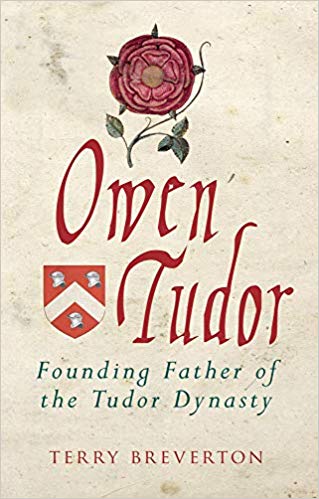
 Henry VII winning at the Battle of Bosworth Field on August 22, 1485, is viewed as the beginning of the Tudor Dynasty. However, the story of the Tudor family goes back centuries in Wales. What we consider the story of the Tudors tends to start with a man named Owen Tudor, a servant, who fell in love and married the dowager Queen of England, Catherine of Valois. Quite a romantic tale, but how much of it is true? Were the Tudors simple folk or did they have a bigger role to play in their native Wales? What roles did Owen and his sons play in the Wars of the Roses? These questions and more are explored in Terry Breverton’s latest biography, “Owen Tudor: Founding Father of the Tudor Dynasty”.
I would like to thank Amberley Publishing for sending me a copy of this fascinating biography. Owen Tudor is someone that has always interested me, so I was quite delighted to find out that Breverton had written the first biography about this extraordinary man and his life.
Breverton begins by exploring the origins of the Tudors and how the Welsh bards were the ones who helped preserve the history and prophecies of Wales for future generations. One such prophecy was the prophecy of Cadwaladr, which speaks of the red dragon of Cadwaladr defeating the white dragons of those who the Welsh considered barbarians. It was also the Welsh who believed that a mab darogan (“the son of prophecy”) would conquer England. Breverton must discuss these ideas because they would help the Tudors gather support that was necessary for future victories. Breverton also discusses the history of Wales and England and the Glyndwr War. He explores the Tudor family tree and how Owen Tudor’s ancestors were very influential in the decisions that Wales made in these critical years. I found this part extremely fascinating to read because casual readers of the Wars of the Roses do not read about Welsh history and the Tudor ancestors, which is vital to understand how they were able to come out victorious in the end.
Breverton also explores the family history of Catherine of Valois and how she came to marry King Henry V and her relationship with her first son, King Henry VI. However, the center of Breverton’s book is centered around the relationship between Owen Tudor and Catherine of Valois. He describes it as the “strangest marriage in English history”, but unlike other scholars, Breverton believes that an actual marriage did happen between Owen and Catherine. Their sons, Edmund and Jasper Tudor, would prove extremely important men during the Wars of the Roses, and tried to bridge the gap between the Yorks and the Lancasters. Breverton was able to track down where Owen was during his service during the Hundred Years’ War and the Wars of the Roses through his sons and through government records of the time, until his death shortly after the Battle of Mortimer’s Cross, on February 4, 1461. The one thing I wish Breverton would have included were maps of Wales, England, and France so it would be easier to understand which towns fell and where battles were fought.
Breverton does a superb job shedding light on Owen Tudor’s fascinating life and legacy. It was an absolute joy to read, I didn’t want it to end. This was my first time reading a book by Terry Breverton and now I want to read more of his books. Breverton blends an easy to understand writing style while maintaining scrupulous attention to details. You can tell that Breverton meticulously researched Owen Tudor and the events that shaped him. This may be the first biography about Owen Tudor, but I don’t think it will be the last. If you want to read a fabulous biography about Owen Tudor and the origins of the Tudor Dynasty, I highly encourage you to read “Owen Tudor: Founding Father of the Tudor Dynasty” by Terry Breverton.
“Owen Tudor: Founding Father of the Tudor Dynasty” by Terry Breverton will be published in the US on November 1, 2019. If you would like to pre-order a copy of this book, please follow the link: https://www.amazon.com/Owen-Tudor-Founding-Father-Dynasty/dp/1445694379/ref=sr_1_1?keywords=Owen+Tudor+Founding+Father+of+the+Tudor+Dynasty&qid=1566589023&s=books&sr=1-1
 In history, many people tend to focus on the big names. The kings and queens, the rebels, and those who really made an impact. The political advisors and men of the church tend to get left behind in the dust since they are not seen as “important”. However, it is these men who were the backbone of the monarchy, who helped make the king’s vision come to fruition. They tend to come and go, so that is why John Morton’s story is so extraordinary. John Morton helped three separate kings of England, was the enemy to a fourth king, tried to reform the church, and had numerous building projects. His life tends to be overshadowed by the kings that he served, but his life is brought into the light in this biography by Stuart Bradley, “John Morton: Adversary to Richard III, Power Behind the Tudors”.
 Historically, royal marriages have been viewed with such interest. A king and a queen who can come from either similar or different backgrounds in order to make their country better, or in some cases, worse. During the Wars of the Roses, there were some legendary relationships that shaped the war between the Yorks and the Lancasters. Edward IV and Elizabeth Woodville. George Duke of Clarence and Isabel Neville. Richard III and Anne Neville. Henry Tudor and Elizabeth of York. However, these relationships fail in comparison to the impact that the marriage of Henry VI and Margaret of Anjou had on England during this time. Henry VI was seen as a weak, pious ruler; Margaret was seen as too strong for a woman. They have been viewed separately for a long time, never as a couple. That is until Amy Licence wrote her latest biography, “Henry VI and Margaret of Anjou: A Marriage of Unequals”.
 Every family has their own stories. Stories of how they became a family, how they fought hard to get where they are today. Stories filled with love, drama, and endurance. When it comes to royal families, their stories tend to be broadcast to the masses, and none more so than the Tudors, who have captured the imagination of history lovers for generations. The Tudor’s story is often told in parts, focusing on individual people like Henry VIII or Elizabeth I. The Tudor story is fascinating told in parts, but as a whole, one sees how hard they worked to become a dynasty that will be remembered for centuries after their deaths. It is time for the story of this extraordinary family to be told as a whole and Leanda de Lisle does so in her book, “Tudor”.
 The Wars of the Roses was a time of great hardships and strong men and women who did everything they could in order to survive. One of these remarkable people was a woman who did everything she could to make sure her only son lived and prospered. She was the daughter of a man who, allegedly committed suicide, she had four different husbands and gave birth to her son at the age of thirteen. She helped organize rebellions and a marriage that helped her son win the throne of England. Her name was Margaret Beaufort, the mother of King Henry VII. Her remarkable story is told in Elizabeth Norton’s insightful book, “Margaret Beaufort: Mother of the Tudor Dynasty.”
 In recent years, the study of the English conflict known as the “Wars of the Roses” has become rather popular. The Lancasters and the Yorks fighting for the English throne. Only one can be the winner. When we do look at this time period, we tend to focus on the people involved in the battles and the political aspect of the conflict. The battles, how they were fought, and why the conflict started in the first place tend to be pushed to the sideline. That is not the case with this particular book. In Hugh Bicheno’s book, “Battle Royal- The Wars of the Roses: 1440-1462”, the political and military aspects combine with family histories for a comprehensive look into what made this time period so fascinating.
 By the year 1470, England had been embroiled in a civil war between the houses of York and Lancaster for nearly 20 years. Edward IV was king until he was driven out of the country by his former best friend Warwick and Edward’s own brother, George Duke of Clarence. The House of Lancaster is back in charge with Henry VI, but Edward IV and his other brother Richard Duke of Gloucester are not giving up without a fight. However, there is another family who wants to fight for the throne, the Tudors. How will it come to an end? Who will become King of England when all the major battles come to an end? These questions are answered in Conn Iggulden’s thrilling conclusion to his Wars of the Roses series, “Ravenspur- Rise of the Tudors.”
 The deaths of the Duke of York, Earl Salisbury and Edmund Earl of Rutland at the Battle of Wakefield at the end of 1460 marked a changing point for how the Wars of the Roses was fought. Now it was not going to be simply a matter of who was going to be the King of England, but it was a war of revenge. What the Lancastrians did not realize at the time was the fact that these deaths would unleash two men who would mark the destruction of the Lancastrian cause; Edward Duke of York, the future King Edward IV, and Richard Neville Earl of Warwick “the Kingmaker”. In the third book of Conn Iggulden’s Wars of the Roses series called “Bloodline”, Iggulden explores the rise of these two dynamic men and how family matters tore the two best friends apart.
 England is on the brink of civil war. Families with royal blood in their veins are fighting amongst each other as King Henry VI has fallen ill. Mistrust runs rampant and sacrifices are made in order to gain the throne. This is the England of 1454 and the beginning of the period in English history that we know today as the Wars of the Roses. Families like the Nevilles, the Percys, and the houses of York, Lancaster, and Tudor would gain fame and infamy during this time. Conn Iggulden decided to explore this tumultuous time after the Jack Cade rebellion, which he explored in his first book “Stormbird”, in the second book of his “Wars of the Roses” series called “Trinity”.
 The Wars of the Roses is often remembered for the battles that were fought in England. Bosworth. Towton. Barnet. Tewkesbury. These battles and the names of the men and women like Richard III, Margaret of Anjou, Henry VI, Richard Duke of York, Edward IV and the Tudors are etched into the history of England. However, what started this conflict was not on the battlefield, it was inside the English Court. The decisions of a few men led to revolts that swept throughout England. So what was life like during this tumultuous time in English history? That is one of the questions that Conn Iggulden wanted to explore in his book series, “Wars of the Roses”. The first book in the series is called “Stormbird” and it explores the time after Henry VI marries Margaret of Anjou as well as Cade’s Rebellion, which wanted to tear England apart.
 Adventures of a Tudor Nerd