
 Today, I am pleased to welcome Clare Marchant to my blog to discuss her latest novel, “The Queen’s Spy,” and her use of dual timelines. I would like to thank The Coffee Pot Book Club and Clare Marchant for stopping by on this tour.
I have always loved reading dual timeline novels. I love history (of course!), and although I also read many historical books, both fiction and non-fiction, I love that connection between the past and the present, waiting to find out when the two worlds will meet.
I often wax lyrical about how I am fascinated with the connections that bind us all together, whether family ties, our links to places, objects, or indeed each other. We are all woven together by the way that we are threaded together with everything that we touch. We all have special items, be it family heirlooms or gifts, jewelry, or a book; perhaps that means something special to us. Something that will eventually belong to someone else. When it comes to history, these associations take on a whole new persona as they link over the years or centuries, and I love investigating this through my writing by tying the two stories together through a shared theme, a shared connection.
In Saffron Hall, that relationship, the object that tied the two stories together, was the book of hours. I have a fascination for old illuminated manuscripts, so I wanted to use one of these exquisite small prayer books as the object that united together my two protagonists, showing how the theme, ‘while I breathe, I hope’ touched the lives of them both. They both learn that they must live with the hurt they have endured and to keep taking each day at a time until things get better – they keep breathing and keep hoping. That eventually, time will help them to move on.
In The Queen’s Spy, the object is the triptych that Tom paints, showing his journey, which mirrors in some respects the one in the present day that Mathilde is taking. They are both connected by their shared background of being shunned by society for separate reasons. By being ‘different’ and having to face prejudice and leaving them to lead a peripatetic lifestyle never accepted by those around them. They are always searching for somewhere they will be recognized for who they are and loved for it. By investigating the painting, Mathilde begins to learn more about herself and her place in this world. And she learns the book’s theme, that she cannot change the past, but she can change the future.
The reason why I choose present-day as my alternative timeline to the Tudor one is that despite the apparent differences to our daily lives between the way we now live compared to how they did in the sixteenth century, I think it shows just how much these morals that guide us affect us all whenever we lived. We are just the same in our hearts, with similar fears, hopes, desires, and despair. People love, they grieve, they laugh, and they cry. In every life, there are shared experiences, precious objects…and precious people.
 (Blurb)
1584: Elizabeth I rules England. But a dangerous plot is brewing in court, and Mary Queen of Scots will stop at nothing to take her cousin’s throne.
There’s only one thing standing in her way: Tom, the queen’s trusted apothecary, who makes the perfect silent spy…
2021: Travelling the globe in her campervan, Mathilde has never belonged anywhere. So when she receives news of an inheritance, she is shocked to discover she has a family in England.
Just like Mathilde, the medieval hall she inherits conceals secrets, and she quickly makes a haunting discovery. Can she unravel the truth about what happened there all those years ago? And will she finally find a place to call home?
Buy Links:
Amazon UK: https://www.amazon.co.uk/Queens-Spy-gripping-historical-fiction-ebook/dp/B08R6Q4CC9
Amazon US: https://www.amazon.com/Queens-Spy-gripping-historical-fiction-ebook/dp/B08R6Q4CC9
Amazon CA: https://www.amazon.ca/Queens-Spy-gripping-historical-fiction-ebook/dp/B08R6Q4CC9
Amazon AU: https://www.amazon.com.au/Queens-Spy-gripping-historical-fiction-ebook/dp/B08R6Q4CC9
Barnes and Noble: https://www.barnesandnoble.com/w/the-queens-spy-clare-marchant/1139196760
Waterstones: https://www.waterstones.com/book/the-queens-spy/clare-marchant/9780008454357
Kobo: https://www.kobo.com/gb/en/ebook/the-queen-s-spy-2
iBooks: https://books.apple.com/gb/book/the-queens-spy/id1554626619
Audio: https://amzn.to/2QRzT2K
 Author Bio:
Growing up in Surrey, Clare always dreamed of being a writer. Instead, she followed a career in IT before moving to Norfolk for a quieter life and re-training as a jeweler.
Now writing full time, she lives with her husband and the youngest two of her six children. Weekends are spent exploring local castles and monastic ruins or visiting the nearby coast.
Social Media Links:
Twitter: https://twitter.com/ClareMarchant1
Facebook: https://www.facebook.com/claremarchantauthor
Instagram: https://www.instagram.com/claremarchant1/?hl=en
Amazon Author Page: https://amzn.to/3fkuf2r
 Two cousins fighting for the right to rule England during the 16th century. One was the daughter of Henry VIII and Anne Boleyn who fought tooth and nail to rule without a man by her side. The other was the daughter of Mary of Guise and King James V of Scotland whose marriage record would prove to be fatal. Elizabeth I and Mary, Queen of Scots, may have been sister queens, but the way they were treated in their own countries differed completely. While Elizabeth I was praised and protected from harm in England, Mary was a scapegoat for so many in Scotland. The way that Mary was used as a pawn even though she wore a crown was nothing short of extraordinary. The story of how these two queens came on a collision course that would leave one queen beheaded and the other forever changed has been told in many different ways from both sides of the tale, but it has rarely been told as a cohesive nonfiction book. That is until Kate Williams’ marvelous biography, “The Betrayal of Mary, Queen of Scots: Elizabeth I and Her Greatest Rival”.
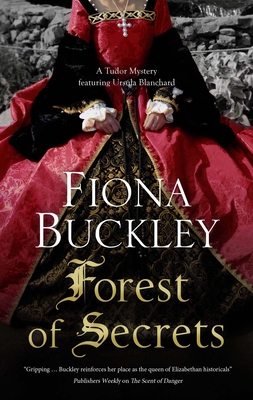 The year is 1586 and Ursula Blanchard is on a mission to protect Queen Elizabeth I. After returning home from a previous mission, Ursula and her household come into contact with a countrywoman named Etheldreda Hope who has brought a peculiar case to the forefront. In the forest by the village that Etheldreda calls home, there have been strange rituals occurring that include reference to an evil queen. Are these rituals harmless or is there a sinister motive behind the beliefs of the pagans who meet in the forest? Will Ursula and her household solve the case in time? This is the premise of Fiona Buckley’s latest Ursula Blanchard Tudor mystery, “Forest of Secrets”.
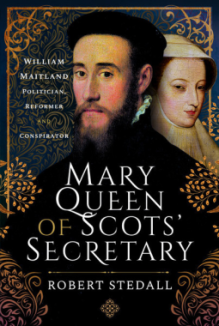 One of the most dynamic queens in 16th century Europe who spent most of her youth in a country that was not her homeland, but was fighting for the right to rule England. Her name was Mary Queen of Scots, the cousin of Queen Elizabeth I. Many know of her tragic tale, but there was a man who was behind the scenes trying to guide Scotland to a brighter future. He was not married to Mary Queen of Scots, but he was influential in her life and choosing who she might marry and who she would end up divorcing. He was a politician and a religious reformer whose decisions would alter history dramatically. His name was William Maitland and he served as Mary’s secretary. He is always mentioned as a footnote in history, until now. Robert Stedall’s latest biography, “Mary Queen of Scots’ Secretary: William Maitland- Politician, Reformer, and Conspirator”, explores the life and legacy of this rather extraordinary secretary.
 In history, we tend to focus on the stories of the men and women who shaped the era. This is obviously important, but the locations where the events of the past happened are equally as important. Sadly, many of the buildings that the men and women from the past knew no longer exist. However, there are a few, especially from the Tudor period, that we can still visit. Suzannah Lipscomb explored over 50 of these remarkable buildings and decided to tell their tales in her book, “A Journey Through Tudor England”.
 The 16th century was filled with extremely strong women who went on to shape European and world history forever. This was true for England and Scotland, two countries whose stories were intertwined by powerful women. The women who ruled these two countries during this time were women that those who study this time period know about; Lady Jane Grey, Mary I, Elizabeth I, and Mary Queen of Scots. There was one woman who knew all four of these women and lived for over 80 years: Bess of Hardwick, Countess of Shrewsbury. The story of these five women is told in Jill Armitage’s book, “Four Queens and a Countess: Mary Queen of Scots, Elizabeth I, Mary I, Lady Jane Grey and Bess of Hardwick: The Struggle for the Crown”.
 The study of the Tudors tends to focus on England as a country of focus, however the Tudors did affect other countries like Spain, France, and Scotland. Many know the story of Mary, Queen of Scots and her relationship with Elizabeth I, but many do not know the tale of her mother, Marie de Guise. Her tale is one of love for her family and her adoptive country of Scotland. It is of loyalty and strength to do what she believed was right. She was a sister, a daughter, a mother, a queen, and a regent of Scotland. Marie’s story tends to be overshadowed by her daughter’s tragic tale, until now. Her story is the main focus of Melanie Clegg’s latest biography, “Scourge of Henry VIII: The Life of Marie de Guise”.
 After the death of Henry VIII and Edward VI, there was an explosion of religious intolerance, not just in England, but in Europe as a whole. Many believe that it was Mary I “Bloody Mary” who really started this trend, however, the fires of hatred between Protestants and Catholics extended further into the reigns of Elizabeth I and James I of England. We often focus on the monarchs and their inner circles during this time and how the religious persecutions affected the decisions that they made. That tells only part of the story, but how did this religious fighting between Protestants and Catholics affect the normal person? What were their lives like? Ken Follett explores this topic in his third book in his historical fiction series, the Kingsbridge Series, “A Column of Fire”.
  (Born October 8, 1515- Died March 7, 1578)
 Adventures of a Tudor Nerd