 Today, it is my pleasure to welcome back to the blog Tony Riches to share an excerpt from his latest Elizabethan novel, “Raleigh: Tudor Adventurer. I want to thank Tony Riches and The Coffee Pot Book Club for allowing me to be part of this tour.
Excerpt
I’d never seen the presence chamber so crowded. The queen sat on her gilded throne, flanked on both sides by her ladies in their best gowns. Every space was filled with courtiers, and I was pleased to see all the members of the Privy Council, including Lord Burghley and my nemesis, Sir Christopher Hatton.
There were gasps and muttered comments as we entered. I’d been right. Her Majesty’s newest subjects were the talk of London, and I had become the center of attention. I strode forwards and bowed, relishing the moment.
‘Your Majesty, I present Manteo and Wanchese, from the New World, now claimed as the empire of Virginia.’
Although we’d provided them with warmer clothing, as they suffered with the cold of London in autumn, they were bare-chested and bare-footed, showing their tattooed bodies. With iridescent feathers in their plaited hair, they dressed in loincloths, with black furs draped over their shoulders, increasing their wild appearance.
As prepared in our rehearsal at Durham House, they marched confidently through the crowded chamber and fell to their knees before the queen. Manteo greeted her in his own language, then Wanchese opened a small box containing the bracelet of pearls.
The queen stared at her visitors with open curiosity, then took the pearl bracelet and turned to me. ‘We wish to thank them. Do they understand any English?’
‘These men are chieftains of their people, and the bracelets are a gift from their queen, Your Majesty. Chief Manteo is learning a little English, and Master Thomas Harriot is learning what he can of their language.’
‘Tell Master Harriot to explain that we thank their queen for her gift, and commend their bravery in making the journey to England.’ She turned the pearl bracelet in the light and looked up at me. ‘Did your men discover gold or jewels?’
‘What they found is worth more than gold or jewels, Your Majesty.’ I paused and looked around the chamber, aware of my new status. ‘They discovered rich, fertile land, stretching as far as they could see, and claimed it in the gracious name of Your Majesty.’ I pointed to Manteo and Wanchese. ‘These men made my captains most welcome, and will help us understand the opportunities of the country of Virginia for the benefit of your colonists.’
* * *
The first of my rewards proved a surprise. I’d been appointed the junior Member of Parliament for Devon. Parliament had not met for twelve years, and my tax on broadcloth exports was unpopular with influential wool merchants in Exeter, so my new appointment was unexpected.
Sir Francis Walsingham was quick to explain. ‘This is the fifth meeting of the queen’s reign, which the Privy Council has recommended to discuss national security.’
‘There is talk at court that the Throckmorton Plot is only part of a wider Catholic conspiracy.’
Sir Francis nodded. ‘My informers on the Continent discovered plans for an invasion of England led by Henry, Duke of Guise, financed by the Spanish and the Vatican.’ He frowned. ‘We have to do whatever we can to prevent a simultaneous revolt of English Catholics.’
‘Do you think they might try?’ With a jolt, I realized how quickly everything I’d built up could vanish, like a morning mist.
‘You’ve seen the seditious pamphlet they call Leicester’s Commonwealth?’
‘I have, but no one, apart perhaps from the Earl of Leicester, takes it too seriously—’
‘That’s where you’re wrong, Master Raleigh. The Catholic faction draws encouragement from such works, and there are thousands of copies in circulation on the Continent. The pamphlet is a threat to our queen. We mustn’t forget Prince William of Orange was murdered by a man he trusted, a Catholic named Balthasar Gérard, who used a pistol at close range.’ Sir Francis shook his head. ‘He was assassinated at dinner in his own house, a reminder why we have to be prepared for anything.’
‘What do you wish me to do?’
‘A new act is to be put before Parliament, for the safety of the queen, to prevent any open invasion or rebellion, or any attempt to injure Her Majesty. Any person found guilty will be disbarred from inheriting the throne, and sentenced to death for treason.’
‘Including the queen’s cousin, Mary, Queen of Scots?’
He nodded. ‘Catholic sympathizers in Parliament will do all they can to delay, so use your influence to ensure the act is passed.’
I looked at him in surprise. I had no experience of politics or as a Member of Parliament and hadn’t seen myself as capable of political influence. Sir Francis Walsingham sat like a spider in the complex web of court, and his words proved that, at last, I’d achieved my ambition.
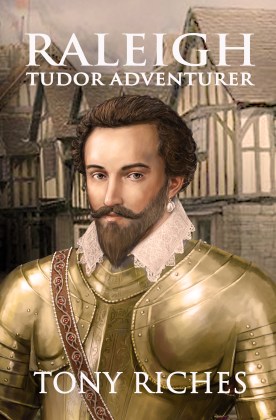 Raleigh – Tudor Adventurer
(The Elizabethan Series, Book 3)
By Tony Riches
Blurb
Tudor adventurer, courtier, explorer, and poet Sir Walter Raleigh has been called the last true Elizabethan.
He didn’t dance or joust, didn’t come from a noble family, or marry into one. So how did an impoverished law student become a favorite of the queen and Captain of the Guard?
The story, which began with the best-selling Tudor trilogy, follows Walter Raleigh from his first days at the Elizabethan Court to the end of the Tudor dynasty.
Buy Links:
Available on #KindleUnlimited.
Universal Link: mybook. to/Raleigh
Amazon UK: https://www.amazon.co.uk/dp/B09Z98J183
Amazon US: https://www.amazon.com/dp/B09Z98J183
Amazon CA: https://www.amazon.ca/dp/B09Z98J183
Amazon AU: https://www.amazon.com.au/dp/B09Z98J183
 Author Bio:
Tony Riches
Tony Riches is a full-time UK author of best-selling historical fiction. He lives in Pembrokeshire, West Wales, and is a specialist in the lives of the Tudors. He also runs the popular ‘Stories of the Tudors Podcast’ podcast and posts book reviews and guest posts at his blog, The Writing Desk. For more information, visit his website tonyriches.com and find him on Facebook and Twitter @tonyriches.
Social Media Links:
Blog: https://tonyriches.blogspot.com/
Website: https://www.tonyriches.com/
Podcast: https://tonyriches.podbean.com/
Twitter: https://twitter.com/tonyriches
Facebook: https://www.facebook.com/tonyriches.author
Instagram: https://www.instagram.com/tonyriches.author/
Amazon Author Page: https://www.amazon.com/author/tonyriches

 Two women who served Anne Boleyn must deal with the ramifications of staying on opposite sides of the queen’s downfall. One is the next bride of King Henry VIII, who must give the king the son he desires or suffer the consequences. The other is a lady in waiting who holds a dark secret and a relic of the past that could be dangerous to both women. Many of us know the story of Jane Seymour, but is there more to the queen who was able to give King Henry VIII the son he desired? What about the mysterious Margery Horsman? What role did she play in Anne Boleyn’s and Jane Seymour’s inner circles? In her third book, “Keeper of the Queen’s Jewels,” Adrienne Dillard tells the tale of these women bonded by fate to work together to survive such a tumultuous time.
 Many actors and actresses have portrayed the lives of Henry VIII and his six wives in modern films and dramas. When asking Tudor nerds which Henry VIII stood out the most, the most popular response is Keith Michell in the 1970s BBC series, “The Six Wives of King Henry VIII.” I had not heard about this series until I started “Adventures of a Tudor Nerd.” Many people have wanted me to watch the series solely for the performance of Keith Michell, so when a coworker allowed me to borrow her DVD copy of the series, I finally decided it was time to tackle this legendary series.
 Three women in one family who shared the same first name saw England change over a tumultuous century. They saw the end of the Plantagenet dynasty and the rise of the Tudors while on the sidelines of great battles. Through heartaches and triumphs, the women of the Woodville family became princesses and queens that would transform the political landscape of England forever. These three women, Elizabeth Woodville, Elizabeth of York, and Elizabeth Grey, were incredible examples of what it meant to be medieval royal women. They are featured in Sarah J. Hodder’s latest book, “The Woodville Women.”
 The year is 1547, and the infamous King Henry VIII is dead. The throne is left to his young son Edward VI while his half-sisters Mary and Elizabeth wait in the wing. Without their powerful father to look after their well-being, his children must navigate the tumultuous Tudor court with powerful men who desire to use them as mere pawns in their game to influence how England is ruled. Throw in some romantic drama and the ever-changing religious landscape with the clash between Protestants and Catholics. This is the premise of the latest Tudor drama on Starz, “Becoming Elizabeth,” which follows the titular Princess Elizabeth Tudor during the reign of the third Tudor king.
 The cast of “Becoming Elizabeth” is a plethora of talented actors and actresses who remarkably bring the treacherous Tudor court to life. The titular role of Princess Elizabeth was played by Alicia von Rittberg, who portrays the young woman’s naivety and eventual strength in love and court politics. Oliver Zetterstrom is the young King Edward VI who struggles to find his identity as a reformer king while navigating the drama of his court and Lord Protectors. Finally, we have Romola Garai, who revolutionized how Princess Mary Tudor was portrayed on television. Garai gives the audience a more sympathetic and vibrant woman trying to hold her family together while defiantly standing up for her Catholic faith in a Protestant court.
 While most of the storylines are engaging, and I found them rather enjoyable, one got under my skin: the intimate relationship between Princess Elizabeth and Thomas Seymour. Now I know it was the central storyline for the first half of this show, but it made my skin crawl. I know that Tom Cullen has discussed this issue with fans, and I think his portrayal of Thomas is spectacular. My problem is with Princess Elizabeth and how she goes along with the relationship to the point of no return. I feel like Princess Elizabeth was much stronger than how she was portrayed during those moments in the show, and she would have turned Thomas down, knowing the false allegations against her mother, Anne Boleyn. I do not think she slept with Thomas Seymour, but I do believe there were elements of flirting between the two, which could have been seen as them having an intimate relationship.
 Today, I am pleased to welcome Sylvia Barbara Soberton to my blog to discuss one of the women featured in her latest book, “Ladies-in-Waiting: Women Who Served Anne Boleyn.”
 Description:
  When we think about the more intimate moments in the medieval period of European history, a few misconceptions and myths come to mind, thanks to historical fiction and medieval movies. The idea that girls as young as twelve were married off to much older men was the norm, and there were such things as chastity belts. Everyone was filthy and smelled awful, so they only married in the spring when they would take their annual baths. And the brilliant idea that the wealthiest lords of the village were able to have their way with the bride on her wedding day. The latest book by Kathryn Warner, “Sex and Sexuality in Medieval England,” aims to eliminate these myths to reveal the truth of the intimate lives of those who lived during the medieval period.
 When we think about the men who surrounded King Henry VIII, a few names come to mind. Cranmer, More, Wolsey, and Wroithesley are just a few, but the man who is synonymous with the infamous king’s reign is Thomas Cromwell. The man who helped Henry get his divorce from Katherine of Aragon saw both the rise and fall of Anne Boleyn. He also assisted in the dissolution of the monasteries and brought reform to England with the break from the Roman Catholic Church. To modern audiences, it feels as if we know everything that there was to know about Thomas Cromwell’s public life, but what was he like in his private life when his friends and family surrounded him? Caroline Angus gives her readers an insight into Cromwell’s personal life in her latest book, “The Private Life of Thomas Cromwell.”
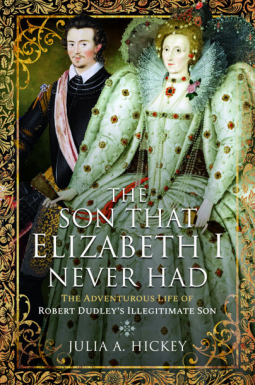 When we study the life of Queen Elizabeth I, the image of a virgin queen who never married tends to come to mind. Of course, she had a man who she favored above all others, Robert Dudley, but he married several times to Amy Robsart and Lettice Knollys. It was with Lettice Knollys that Robert Dudley was able to produce his heir, aptly named Robert Dudley Lord Denbigh, who unfortunately died at a young age. Robert Dudley was left without a legitimate heir, but he did have another son, albeit an illegitimate son, also named Robert Dudley. Julia A Hickey has decided to examine the life of the illegitimate Robert Dudley in her book, “The Son that Elizabeth I Never Had: The Adventurous Life of Robert Dudley’s Illegitimate Son.”
 When we think of those who made an impact in history, we tend to think of those who have been born to a married couple and therefore were considered legitimate children, especially when it comes to royal children. However, we know that illegitimate royal children, like William the Conqueror, greatly impacted history. Illegitimate royal children may have been barred from becoming king or queen of their respective countries of birth, but that does not mean they didn’t impact how their home country was governed. One of these children who affected politics during the Tudor dynasty was Arthur Plantagenet, the illegitimate son of Edward IV. In her latest book, “Arthur Plantagenet: Henry VIII’s Illegitimate Uncle,” she explores the life of this man who gives us extraordinary insight into the running of Calais and how Henry VIII treated other family members.
 Adventures of a Tudor Nerd