
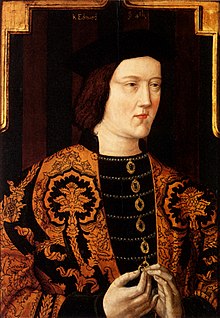
 (Born April 28, 1442- Died April 9, 1483). Son of Richard, 3rd Duke of York and Cecily Neville. Married to Elizabeth Woodville. Father of Elizabeth of York, Mary of York, Cecily of York, Edward V of England, Margaret of York, Richard of Shrewsbury, 1st Duke of York, Anne of York, George Plantagenet, 1st Duke of Bedford, Catherine of York, and Bridget of York. Edward IV was the first king from the house of York, but he was still a Plantagenet. He helped bring the country together, especially financially, but his one flaw was his private life, where he was unwise and naive.
Edward IV was born on April 28, 1442 to Richard, 3rd Duke of York and Cecily Neville, and was given the title of the Earl of March. Richard Duke of York, Edward’s father, was the Lord Protector when Henry VI had his bouts of mental illness, but once the king got well, York was removed from the position and his reforms were reversed. One of his biggest rivals was Edmund Beaufort, Duke of Somerset. In 1455, York had enough of Somerset and marched against him at the First Battle of St. Albans, where Somerset was killed. It was then that Margaret of Anjou took up her husband’s cause. She encouraged the new duke of Somerset Henry Beaufort to fight against York. The battlelines were being drawn. The Yorkists were led by Richard duke of York, Richard Neville earl of Salisbury and his son Richard Neville earl of Warwick. The Lancastrians were under Henry VI, but led by Margaret of Anjou, Somerset, and Henry Percy, third earl of Northumberland. In 1459, at the battle of Ludlow, the Lancastrians won and sent the Yorkists into hiding; however the Yorkists came back with a vengeance at the battle of Northampton.
In 1460 York officially declared his claim to the throne. After much discussion, it was agreed that after the king died, York and his sons would be the heirs to the throne, removing Edward of Westminster from the line of succession. Henry VI seemed to have been okay with this arrangement, but Margaret was beyond upset. She led the Lancastrian forces to face off against York at the battle of Wakefield on December 30, 1460. York and his son Edmund, Earl of Rutland, were killed in the battle. Edward was 18 at the time of his father’s death.
Edward was now in charge of the Yorkist faction and with the help of Richard Neville, the earl of Warwick, he was able to defeat the Lancastrian army at both the battle of Mortimer’s Cross and the Second Battle of St. Albans in February 1461. On March 4, 1461, Edward declared himself king of England, a move that his father never attempted to make. Three weeks later at the Battle of Towton on March 29, 1461, the bloodiest battle on English soil, Edward was able to decisively beat Henry VI’s forces and secure his claim to the throne. Henry VI and Margaret of Anjou fled to Scotland to seek the aid of James III.
Edward was declared Edward IV. He was welcomed to the throne. His focus was to rule wisely and gain the support of the nobles by limiting the policy of court favorites and placed the control of Crown lands under court officials. He wanted to make sure that his court was politically and financially sound. Edward owed a lot to his cousin Richard Neville, Duke of Warwick, also known as “the Kingmaker”, and he rewarded him greatly. He was made the Chamberlain of England and he was considered the second most powerful man in England. Warwick’s son John Neville was made earl of Northumberland after the battle of Hexham in May 1464, a hereditary title that belonged to the Percy family.
Warwick and Edward were considered close. However that would change very quickly. Warwick knew that Edward would have to marry well and so under his own initiative, he set to secure an alliance with the French King Louis XI by marrying Edward IV to the French king’s daughter Bona of Savoy. Edward wasn’t really thrilled about an alliance with France; he had actually prefered an alliance with Burgundy. Edward decided to take the issue of his marriage into his own hands. In May 1464, he secretly married Elizabeth Woodville, the daughter of the 1st Lord of Rivers and Jacquetta Rivers, and the widow of Sir John Grey. They were able to keep the marriage a secret for over four months and when it was announced, there was an uproar. Her family was always supporters of the Lancastrian cause and there was a rumor, that we cannot confirm or deny as of right now, that Edward entered into a similar marriage contract with Lady Eleanor Butler a year or two before he married Elizabeth.
Warwick was obviously the most upset about this marriage because he had spent so much time setting up an alliance with France to be thwarted. With the rise of the Woodvilles, Warwick feared that they would overthrow his title of the second most powerful man in England. Edward thwarted Warwick’s plans to marry his family with the king’s and the final straw for Warwick was when Edward married his sister Margaret to Charles duke of Burgundy, cementing an alliance between England and Burgundy, which was not what Warwick wanted. Warwick realized that the gap between him and Edward was too large.
Warwick decided to side with Edward’s power hungry younger brother George Duke of Clarence, and Louis XI of France, who promised Warwick land in France if he overthrew Edward. Warwick’s plan was to depose Edward and place George on the throne. In July 1469, Warwick successfully married George to his daughter Isabel, which was something that Edward did not approve of. Warwick then started a series of uprisings in northern England; Edward was a popular king but his marriage with Elizabeth Woodville sullied his image a little while Warwick was seen as a national hero. Edward did employ an army, but when he saw that he was outnumbered, he dispersed his army and allowed himself to be captured by Warwick. Warwick had Edward imprisoned in the Tower, but when his reputation began to suffer, he released Edward in October 1469. Warwick and George both decided to reconciled with Edward but Edward never truly trusted either of them ever again.
Warwick knew that if he was going to restore his power, he had to discuss matters with Louis XI and Margaret of Anjou, which meant that he had to defect to the Lancastrian cause, which he did. In September 1470, Warwick and his rebellion made its way to England. John Neville switched sides, which left Edward unprepared and it forced him to leave England on October 2 and seek aid from his brother in law the duke of Burgundy. Warwick removed Henry VI from the Tower and restored him to the throne. Warwick made a mistake and decided to take Louis XI’s advice and declare war on Burgundy. This forced the duke of Burgundy, who had stayed on the sidelines this entire time, to help Edward IV raise an army. Edward returned to England on March 11, 1471. His army defeated Warwick’s army at the Battle of Barnet, where Warwick and John Neville were killed. On May 4, 1471, Edward faced off against the Lancastrian army at the Battle of Tewkesbury, where the Lancastrians were finally defeated and Edward of Westminster was killed. Margaret of Anjou was arrested and shortly afterward, King Henry VI died, possibly murdered under the orders of Edward IV.
Edward IV’s purpose on the second part of his reign was to work on establishing strong alliances, which he did with the dukes of Brittany and Burgundy, and the king of Aragon. In July 1475, Edward decided that he was going to try to recapture the English lands in France. His brothers George and Richard supported this idea, however this ended in disaster and Edward was forced to sign a peace treaty with Louis. George viewed this as a horrible defeat and so he plotted to remove his brother from the throne yet again. This was the last straw for Edward and he had George arrested and tried for treason. George was found guilty and was executed in February 1478; if the story about his execution is correct, he drowned in a butt of Malmsey wine.
Edward was a great supporter of the arts and was the primary patron of printing. He encouraged William Caxton to pursue his goal of printing the first book in England in November 1477. Edward also financed major building jobs at Windsor Castle and Eltham Palace in Kent. Towards the end of his life, Edward fell ill, and on April 9, 1483, he died from either pneumonia or typhoid. He was just 40 years old and he left the throne to his son Edward V.
 Also known as Richard Plantagenet.
 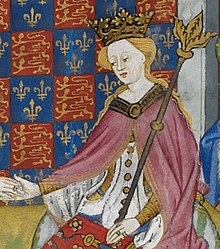 Isabella, Duchess of Lorraine.
 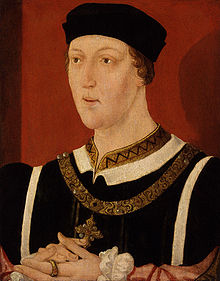 (Born December 6, 1421- Died May 21, 1471).
 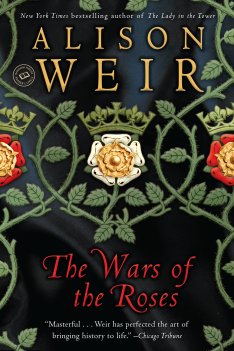 The Wars of the Roses was a series of wars from 1455 until 1487 for the throne of England. It is traditionally taught that it was between the houses of York and Lancaster, yet there were a lot more players involved than these two families. In fact the conflict started much earlier with the children of Edward III and Philippa of Hainault. The Lancasters were the descendants of John of Gaunt and his wife Blanche of Lancaster while the Yorks were descendants of Edmund of Langley Duke of York. This was a series over the question of who had the strongest claim to the throne. This question and the series of wars that would try to answer it is explored in depth in Alison Weir’s book “The Wars of the Roses”.
 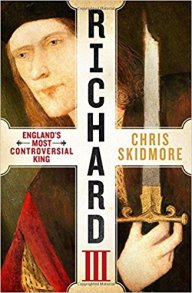 When we often think about Richard III, we tend to focus on the princes in the tower, Bosworth Field where he died, and the discovery of his body in 2012. But he was a brother to a king, a protector and he did rule as king of England. There should be more to his story than this. Chris Skidmore believed so and decided to write a modern biography on Richard called “Richard III: England’s Most Controversial King”.
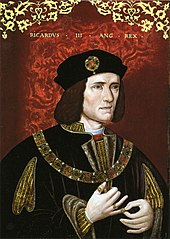 In honor of the third anniversary of the reburial of King Richard III, I have decided to write down my opinions about this controversial king.
 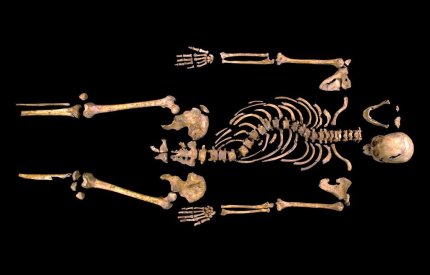 Shakespearean lore. I used to believe this and then his skeleton was discovered under the car park in Leicester. After looking at his skeleton, one would think he would be unfit to fit, but I came across a documentary that proved otherwise. “Resurrecting Richard III” by PBS was able to find a man in England who had the exact same amount of curvature in his back as Richard III. It proved that Richard could fight and that he wasn’t as Shakespeare described
  Just like his father before him, Richard was granted the right to make orders for the king, not because he was well liked, but because he fought against the Woodvilles and the Rivers for the right. He was fighting his brother’s wife’s family for the right to control the country. Richard would have Lord Rivers killed because of “treason” to protect the boy king. Edward V and his younger brother Richard duke of York were led to the Tower of London “for protection” and were never to be seen again after 1483. Since the young king was out of the picture, I believe because Richard had the boys murdered, the only one who had the right to the throne was Richard himself. Just like he planned. To seal the deal, Richard III issued the
  Elizabeth I
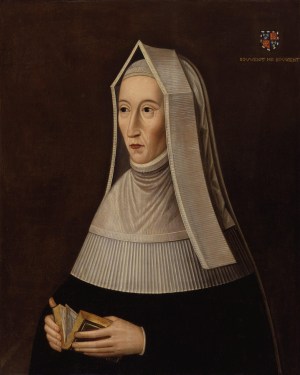 essential. It was a world controlled by men and Margaret played their game well. She was first married to Henry Tudor’s father Edmund when she was around 12 or 13 years old and had Henry when she was either 13 or 14. With the amount of trauma that she endured giving birth to Henry, he was her only child. Only a few months before Henry was born, Edmund died, leaving Margaret a widow and she had to give her son over to an enemy of the Beauforts. As the Wars of the Roses progressed, Henry soon became the last hope for the Lancastrian cause. His life hung in the balance as he and his uncle Jasper was forced into exile. It was through Margaret’s two other marriages that she was able to secure land for her son and was able to help create an army for her son so that he could claim the throne. Most of this she planned while her husband, Lord Stanley, was a strong supporter for the Yorkist cause. This was such a gamble, but the biggest gamble that Margaret made was when she convinced Elizabeth Woodville, the wife of Edward IV, to allow her daughter Elizabeth of York to marry Henry after he defeated Richard III at the Battle of Bosworth Field. All of her hard work paid off after Bosworth and her son Henry Tudor became Henry VII. Margaret had to be very strong in order to survive through all of this turmoil in order to see her only son succeed.
 between their children would help mend the rift in the country. With the marriage between Elizabeth and Henry Tudor, the York and Lancaster houses were united under the red rose of Tudor. I have always wondered what it must have been like for Elizabeth to know that she had to marry Henry who fought on the opposite side of her entire family. At first, it must have been rough but it did develop into love between the two. And then Henry had to deal with men who claimed to be her brothers who were led to the Tower of London and supposedly never heard of again. It must have been hard for Elizabeth to hear about these pretenders who claimed to be her long-lost brothers. At the same time she was building a family with Henry with her sons and daughters. Just when everything was going well for the family, Elizabeth and Henry’s eldest son Arthur died right after he had married Catherine of Aragon, the daughter of Isabella and Ferdinand of Spain. The blow must have rocked their marriage to the core, but luckily they had each other and their other son Henry VIII. It was the love that they had for one another that helped get Elizabeth of York and Henry VII through the rocky patches and helped establish the Tudor dynasty.
 her marriage, to Henry VIII, was arranged all while living in poverty. She could have thrown in the towel and asked to go back home but she stayed and married King Henry VIII, becoming Queen of England. Everything was going fine in their marriage until the miscarriages happened and the fact that she could only give birth to one child, a girl named Mary. This must have felt so horrible for Catherine since Henry only wanted a male heir and she could not give him what he wanted. Henry wanted a divorce and decided to use the fact that she was married to his brother as an excuse to divorce. Since Catherine said she was still a virgin after Arthur died, the Catholic church did not see a reason to hand out the divorce and took a long time to decide so Henry decided to break away from the church and divorced Catherine that way. She was then dismissed to never see him or her daughter Mary again, although she would argue that she was his one true and faithful wife until her dying breath. The amount of courage it must have taken to get through all the Henry through her way is very admirable and inspiring.
 Catherine was a scholar and had written two books, a first for a Queen of England. She acted as a king step mother to Henry’s three children; Edward, Elizabeth and Mary, but she had the best relationship with Elizabeth. After Henry died, Catherine married her sweetheart Thomas Seymour and had Elizabeth live with them. It is rumoured that Thomas Seymour had an inappropriate relationship with Elizabeth. It must have been hard for Catherine to accept this fact and in some cases, it is said that she even assisted Thomas with these incidents. Catherine had to make the hard decision to ask Elizabeth to leave her household, even though she loved her very much. Catherine died giving birth to a daughter. Catherine had to act as a nurse, scholar, wife, and step mother in a time when it was hard to even do one of these jobs properly.
 Adventures of a Tudor Nerd